Crochet Rose Pattern with a Rolled Petal Strip
Make a crochet rose from a graduated petal strip with a green calyx, two leaves and a covered stem. Includes stitch tables, assembly and troubleshooting.
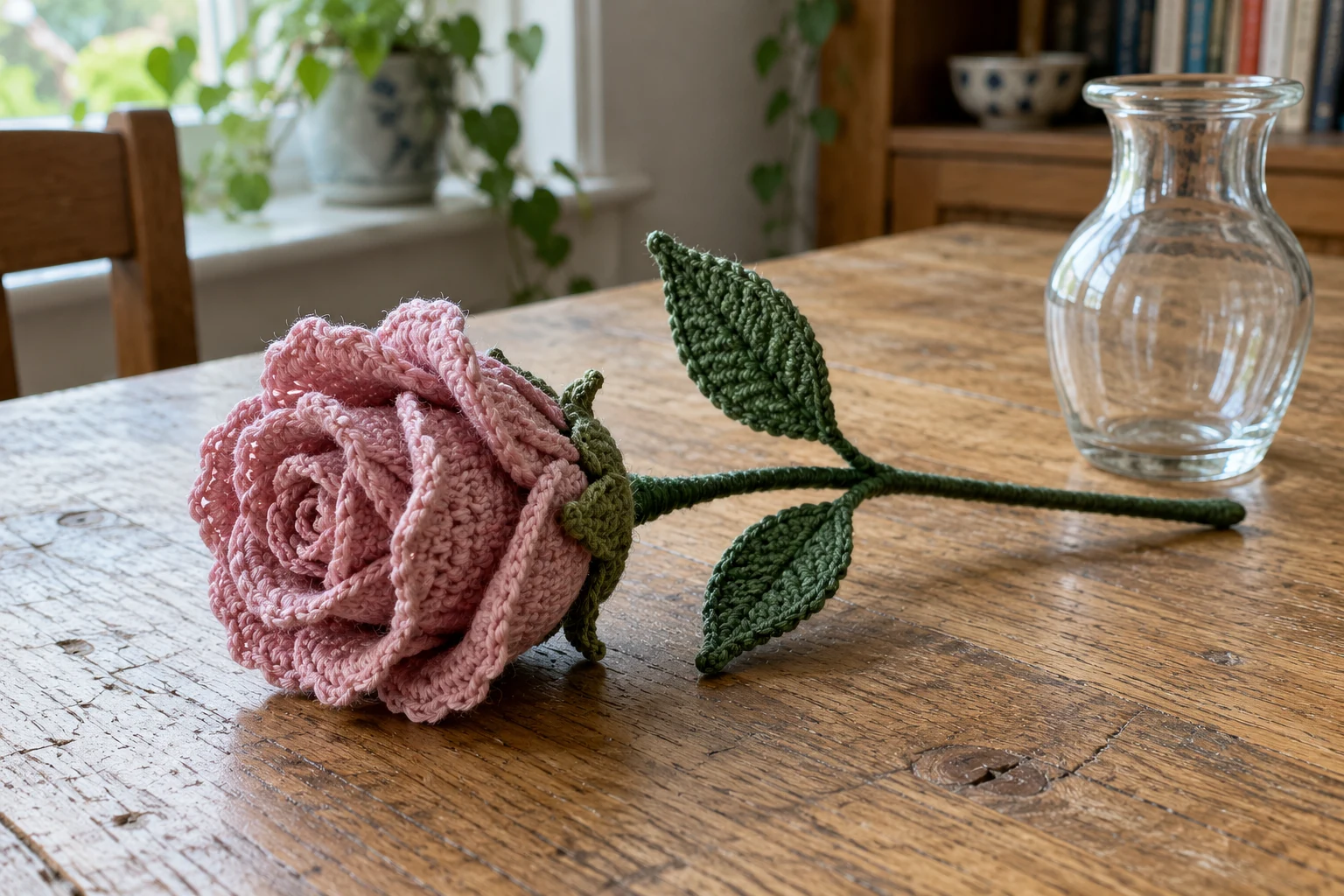
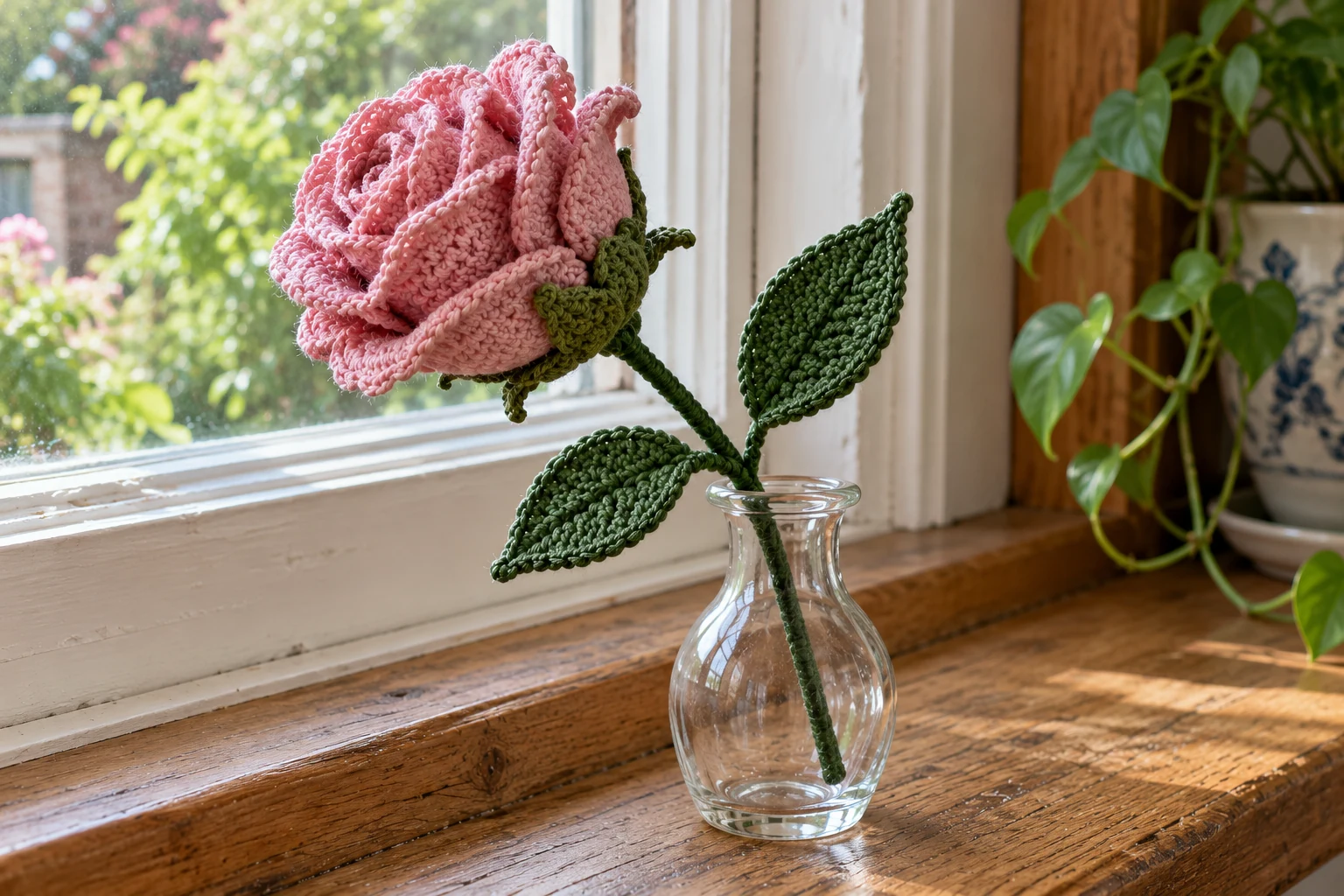
A single crochet rose can be easier to arrange than a large bouquet. This version grows from one scalloped strip: smaller inner petals roll into the center, while wider outer petals open around them. A separate green calyx hides the underside and two leaves finish the stem.
This crochet rose pattern uses rows for the petal strip and simple small pieces for the greenery. The stem is a yarn-covered blunt bamboo support. The flower is decorative and the suggested dimensions remain estimates until the design is test-crocheted.
How is the rose shaped? Crochet ten graduated scallops along a forty-stitch foundation, roll from the smaller petals, and stitch through the solid lower edge. Add the five-point calyx, a covered stem and two leaves. The petals are not ten separate pieces.
Project Overview
| Detail | Pattern information |
|---|---|
| Skill | Confident beginner |
| Terms | US crochet |
| Construction | Rolled petal strip; separate calyx and leaves |
| Hook | 2.5 mm, adjusted to yarn |
| Planning size | Bloom roughly 5–7 cm; stem about 20 cm, unverified |
| Estimated time | About 2–3 hours; experience dependent |
| Testing | Arithmetic reviewed; no physical sample |
Illustrations and testing: The six project images are generated illustrations of the intended design, not photographs of a test-crocheted sample. The written instructions and stitch arithmetic have been reviewed; size, yarn use, handling and construction still need a physical sample check.
Materials
| Material | Suggested specification |
|---|---|
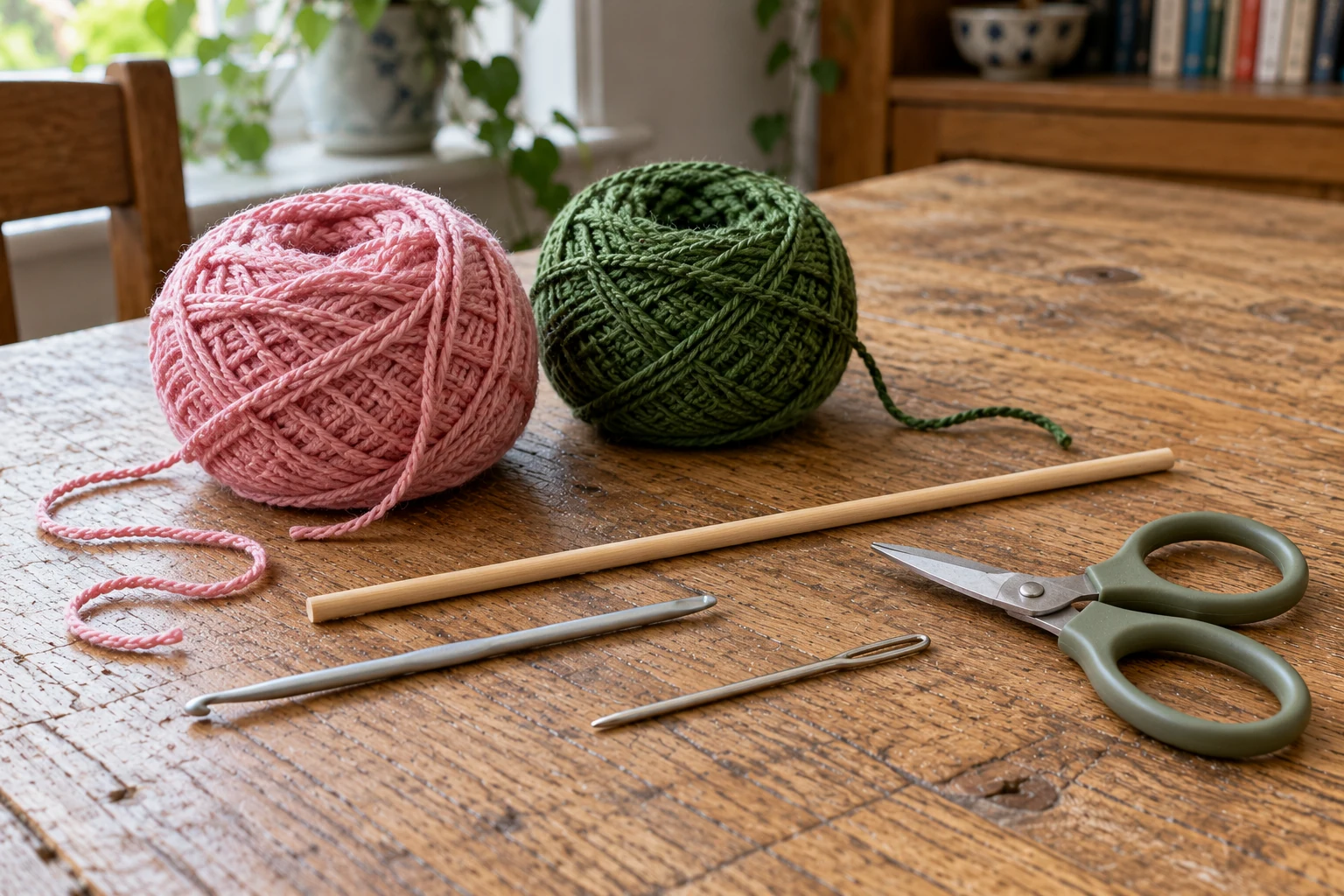
| Pink cotton | Approximately 15–20 g fine/sport cotton, around 125 m per 50 g; estimate |
| Green cotton | Approximately 10 g of matching-weight cotton; estimate |
| Hook | 2.5 mm or suitable size for neat visible stitches |
| Stem support | One smooth blunt bamboo dowel, about 20 cm × 3 mm |
| Notions | Blunt yarn needle, scissors, a few pins for positioning |
Size, Gauge, and Yarn Choices
Use the same yarn family for the bloom, calyx and leaves so the parts stay in proportion. No measured gauge is available for this draft. Crochet the first few scallops and check that they can roll without becoming a hard lump. A thicker yarn makes a larger flower and a much heavier stem head. The support length is chosen before assembly; the bloom diameter depends on stitch height, rolling and tension.
Abbreviations and Working Notes
| Abbreviation | Meaning |
|---|---|
| ch | Chain |
| sc | Single crochet |
| inc | 2 sc in the same stitch |
| dec | Invisible single crochet decrease; consumes 2 stitches and makes 1 |
| sl st | Slip stitch |
| st / sts | Stitch / stitches |
| MR | Magic ring |
| hdc | Half double crochet |
| dc | Double crochet |
The turning ch 1 does not count. Work the petal row into the 40 single crochets, not into foundation chains again. Each scallop consumes four base stitches: skip one, use the next, skip one, then sl st in the fourth.
The strip makes 10 scallops: 3 small, 3 medium and 4 large. Count petals as well as stitches. Turning chains and finishing joins do not count as extra petals.
Keep the lower edge accessible while rolling. Do not stitch across the upper petal tips; they need to remain free to open.
Crochet the Graduated Petal Strip
| Row / section | Instructions | Count |
|---|---|---|
| Foundation | Ch 41 | 40 working chains |
| Row 1 | Sc in second ch from hook and in every remaining ch | 40 sc |
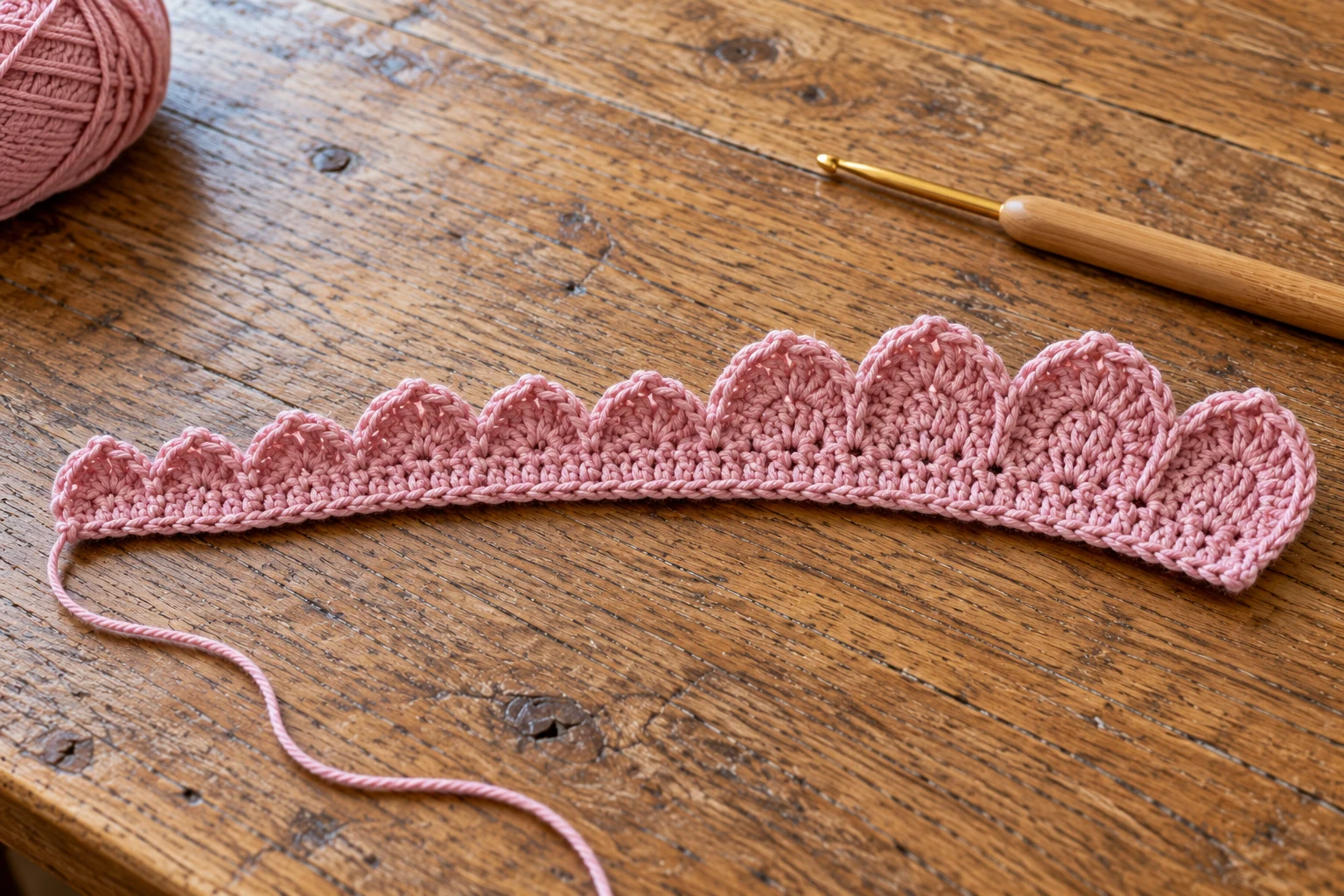
| Row 2, first 3 scallops | Ch 1, turn. Repeat (skip 1 st, 3 hdc in next st, skip 1 st, sl st in next st) 3 times | 3 petals; 12 base stitches used |
| Row 2, next 3 scallops | Repeat (skip 1 st, 5 dc in next st, skip 1 st, sl st in next st) 3 times | 3 petals; 12 base stitches used |
| Row 2, last 4 scallops | Repeat (skip 1 st, 7 dc in next st, skip 1 st, sl st in next st) 4 times | 4 petals; 16 base stitches used |
The complete petal row uses all 40 base stitches and contains 9 hdc, 43 dc and 10 slip stitches, or 62 made stitches. Fasten off with a sewing tail about 45 cm long. Lay the strip out and identify the small-petal end before rolling. Slight curling is expected; severe puckering suggests tight chains or missed skips.
Roll and Secure the Bloom
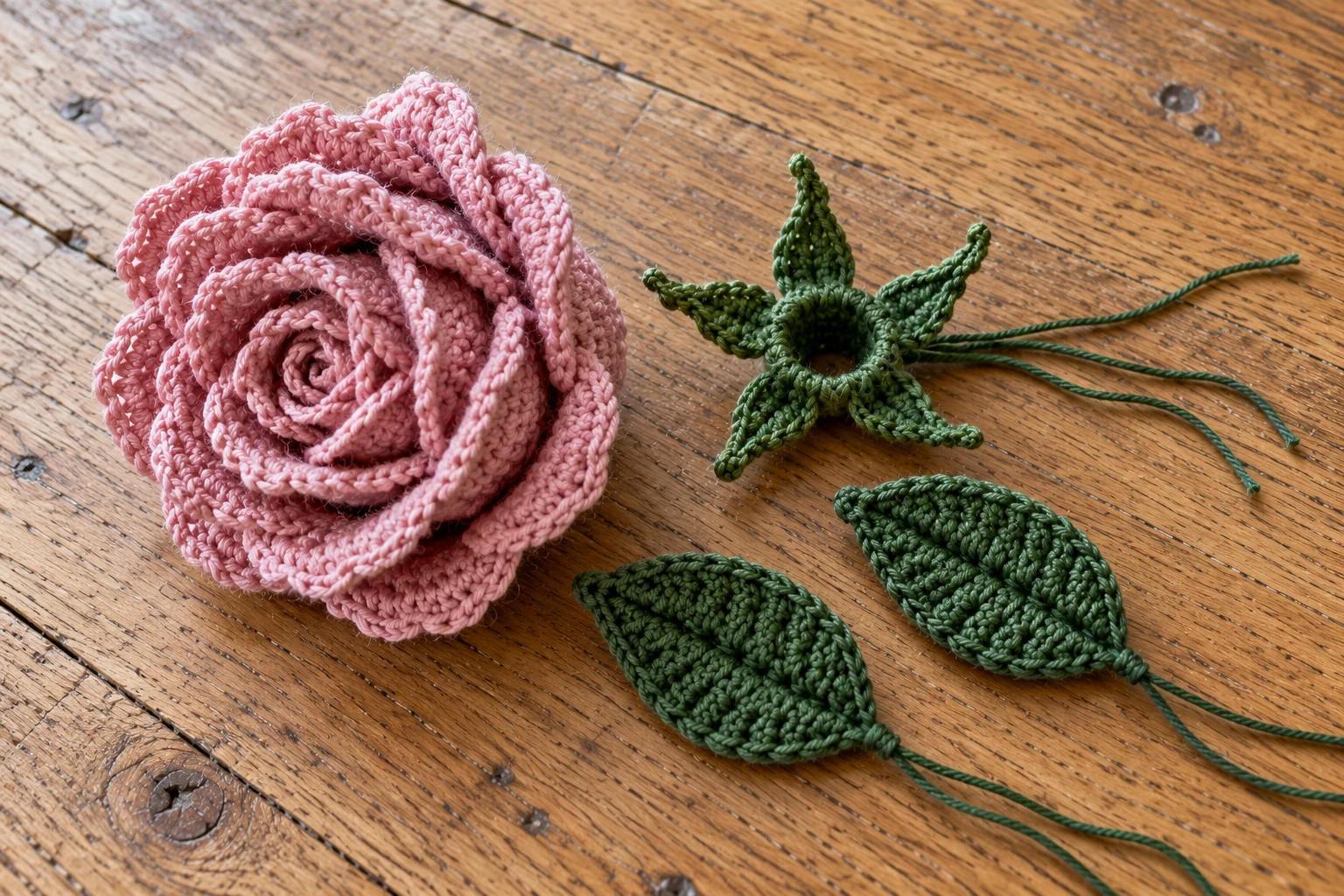
Roll the first three small scallops fairly close together to create the center. Keep the straight single-crochet edge at the bottom. Wrap the medium petals around that center, offsetting their tips so they do not stack directly above one another. Let the last four wider scallops sit more loosely around the outside.
Pin the lower edge temporarily. Turn the bloom over and sew through several layers of the solid lower edge, moving across the base in different directions. Leave a small central space for the stem support. Check the top after every few stitches: if a petal is pulled flat, loosen that stitch before continuing. Do not fill the bloom with stuffing.
Make the Five-Point Calyx
| Stage | Instructions | Result |
|---|---|---|
| Center | 5 sc in MR; join to first sc | 5 base stitches |
| Each point | Sl st in next base st; ch 4. Sl st in second ch from hook, sc in next ch, hdc in last ch; sl st back into the same base st | 1 narrow green point |
| Complete | Repeat the point sequence once in each of the 5 base stitches; fasten off with a sewing tail | 5 points |
The five points sit behind the bloom rather than covering its face. The slips into the ring anchor the points; the three return stitches are worked on the chain. Keep the central hole only large enough for the dowel, and close it with the starting tail after positioning the support.
Crochet Two Leaves
| Part | Instructions | Count |
|---|---|---|
| Foundation | Ch 10 | 9 working chains |
| First side | Starting in second ch: sc 1, hdc 1, dc 5, hdc 1; put 3 sc in last ch | 11 stitches |
| Return side | Along the underside: hdc 1, dc 5, hdc 1, sc 1; join to first sc | 8 more; 19 total |
Make two leaves and leave long tails. The first side uses all nine foundation positions; the return uses the eight available positions before the far tip. Flatten gently with your fingers. If you block the leaves, follow the yarn label and let them dry before attaching.
Cover the Stem and Attach the Greenery
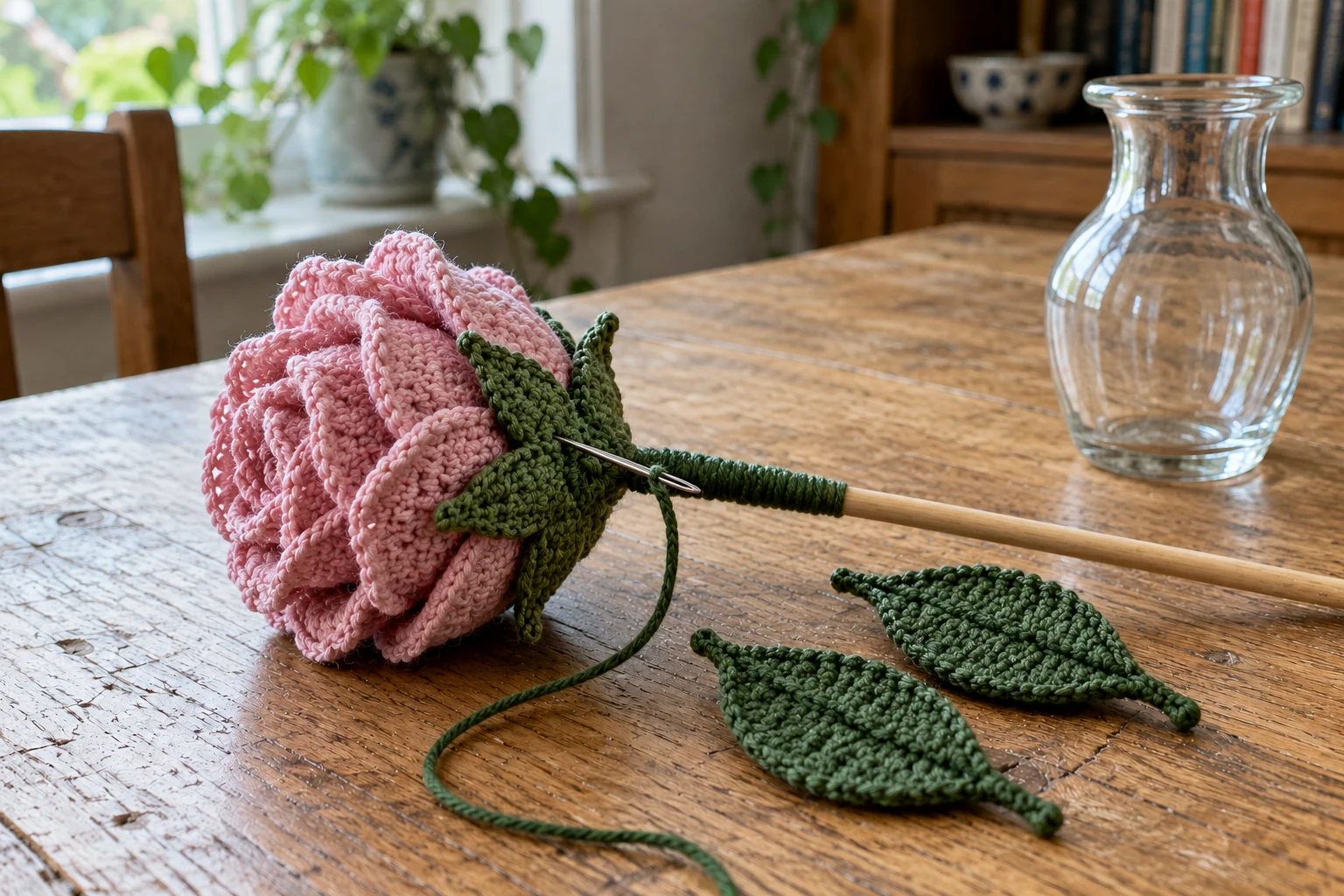
Use a smooth, blunt dowel without splinters. Position its top about 1–1.5 cm inside the underside of the rolled bloom. Sew the bloom base snugly around the support with green yarn, passing through the crocheted fabric around the shaft, not trying to push a needle through the wood. Slide the calyx against the bloom and sew its center and the roots of its five points to the flower underside.
Hold a green yarn tail along the shaft and wrap over it from the flower downward. Keep the wraps touching so the wood does not show. At about one-third of the way down, bind in the sewing tail from the first leaf and make several securing stitches through its narrow base and adjacent wraps. Add the second leaf lower down on the opposite side. Continue wrapping to the blunt bottom.
Secure the final yarn with several tight half-hitches around the covered shaft and weave the end under nearby wraps with a needle. Cover the lower end completely. Check that no wood edge or loose loop is exposed. This friction-and-sewing attachment needs a physical stability check; if the bloom or covering slips, remake the join before using the stem in an arrangement.
Troubleshooting
| Problem | Check | Adjustment |
|---|---|---|
| Bloom resembles a tight bud | Outer petals rolled too firmly | Unroll the outer scallops and resew the lower edge more loosely |
| Strip ends before ten petals | Skipped or doubled foundation group | Use 4 base stitches for every scallop |
| Wood shows through stem | Gaps between wraps | Rewrap closely while keeping the support straight |
| Calyx covers petals | Points attached too high | Move the calyx to the underside |
| Leaves rotate | Loose base attachment | Stitch through the leaf base and several neighboring wraps |
Display and Care
Display one stem in a narrow vase or group separately made flowers at different heights. Keep the yarn away from candle flames, damp windowsills and direct prolonged sunlight. Dust gently with a soft brush. A wooden-supported stem is not intended for machine washing, and the whole flower is a decoration rather than a tested toy.
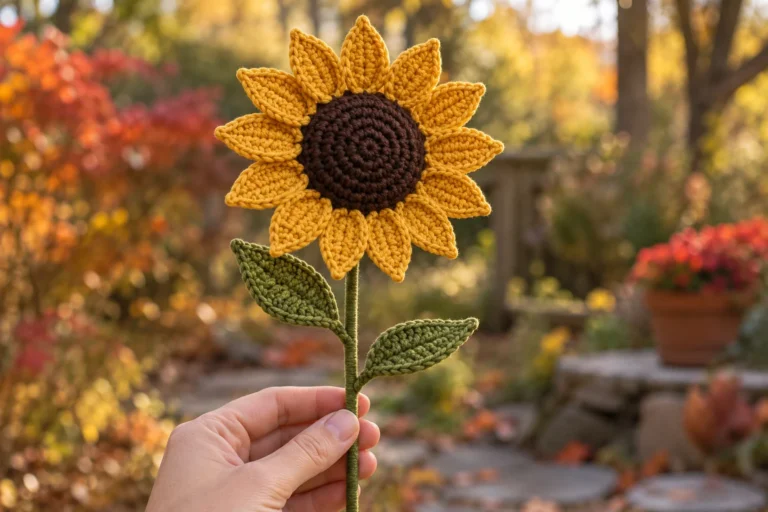
For a different flower construction, see the crochet tulip bouquet or the autumn sunflower. Their flower heads are constructed separately from this rolled-strip rose.
Frequently Asked Questions
Are the petals sewn individually?
No. All ten scallops belong to one strip. Only the solid lower edge of that rolled strip is sewn together.
Can I make a flower without the stem?
Yes. Finish the underside neatly after securing the bloom. The calyx can cover it, but do not leave a loose dowel opening.
Do I need wire?
No. This version uses a straight blunt bamboo support, so it does not bend like a wired stem.
Why are my outer petals too stiff?
Check yarn thickness and tension. Work a test scallop with a slightly larger hook if the fabric cannot curve naturally, then remake the strip consistently.
Can I glue the rose onto the stem?
The written construction uses sewing and wrapping. Glue changes the construction and care requirements, so it is not part of this draft.
Are the quantities measured?
No. They are planning estimates; record actual yarn consumption and finished size when making a sample.
Compact Rose Pattern Card
| Component | Summary |
|---|---|
| Strip | Ch 41; 40 sc; ten graduated scallops using 4 base sts each |
| Petal groups | 3 small hdc, 3 medium dc, 4 larger dc scallops |
| Calyx | 5 sc center; 5 chain-worked points |
| Leaves | Make 2; ch 10 oval, 19 stitches around |
| Finish | Roll, sew lower edge, add calyx, cover support, attach leaves |