Crochet Daisy Flower Pattern with a Separate Center
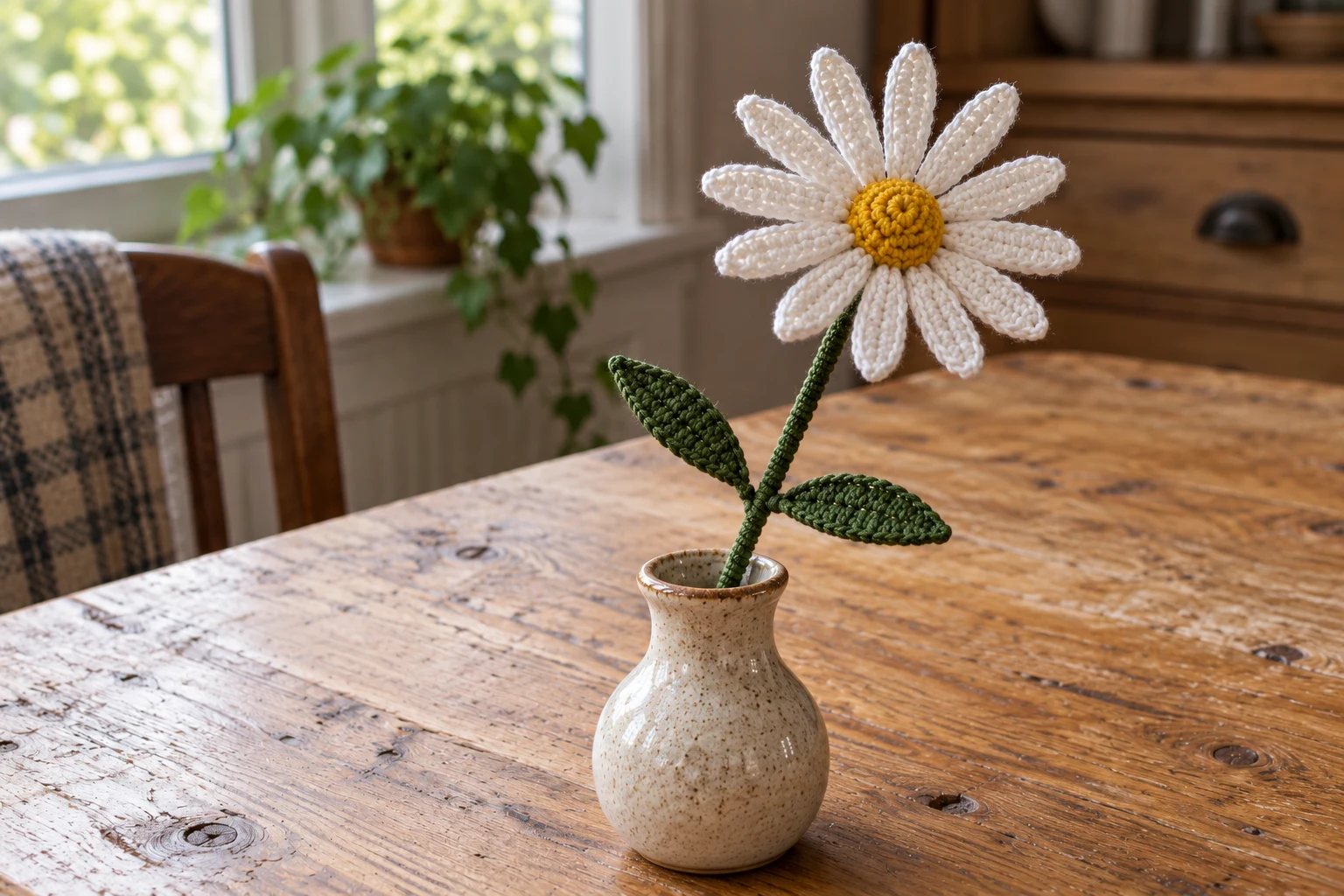
Crochet a white daisy with twelve narrow petals, a raised yellow center and a covered stem. Follow component tables, assembly steps and count checks.
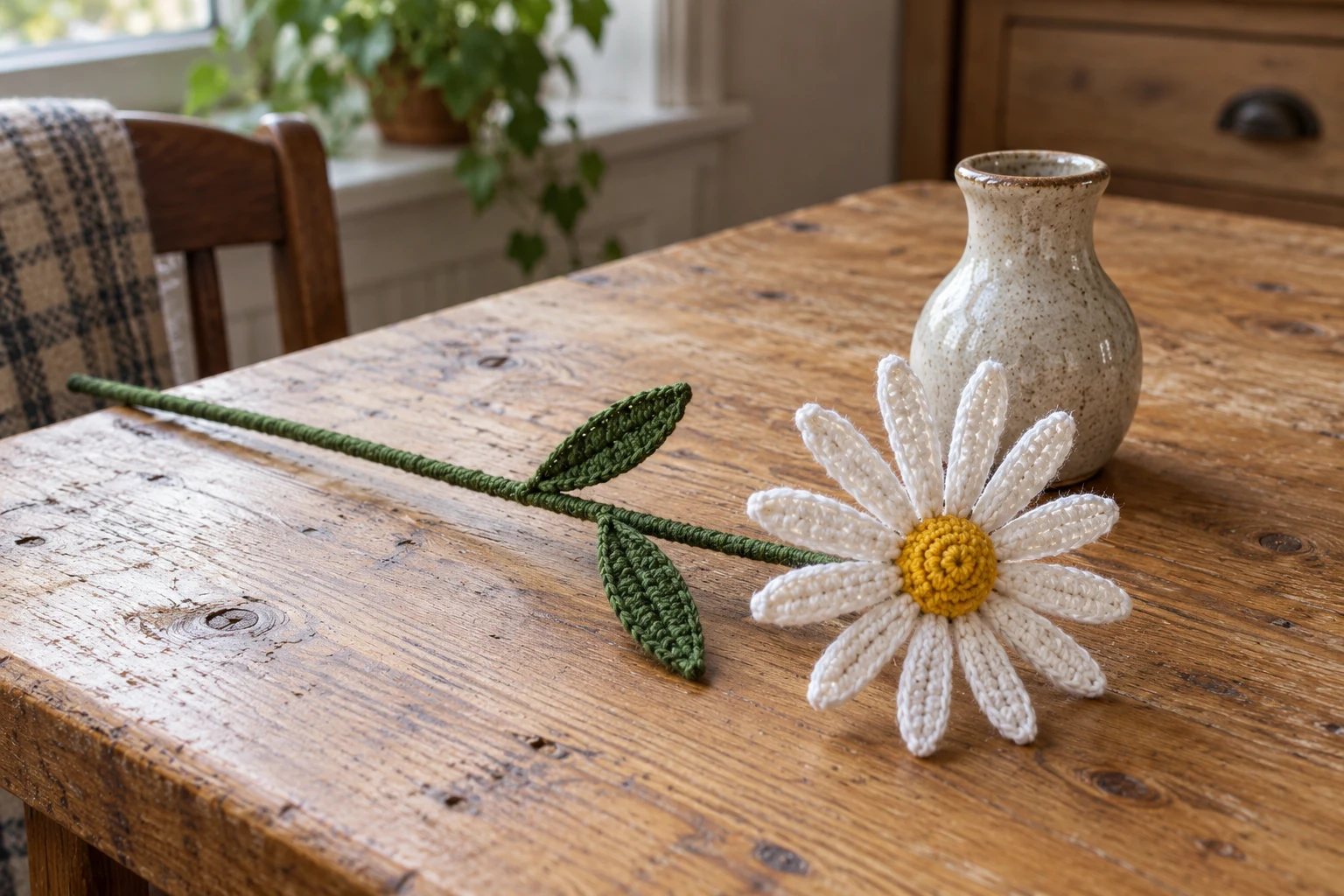
A daisy is defined by its open shape: narrow white rays around a clear yellow center. This small cotton version keeps those elements separate so you can count and space the petals before attaching the stem. Two simple green leaves finish a single flower.
This crochet daisy pattern makes twelve chain-worked petals around the front center. A second small yellow circle covers the reverse and holds a little filling, giving the center a gentle lift without stuffing the petals.
How is this project made? Crochet a 12-stitch yellow front circle. Work twelve narrow white petals into its back loops, then sew a second yellow circle behind it with a little filling. Add a covered blunt stem and two leaves.
Project Overview
| Detail | Pattern information |
|---|---|
| Skill | Confident beginner |
| Terms | US crochet |
| Hook | 2.5 mm, adjusted to yarn |
| Planning size | Flower roughly 6–8 cm across; stem about 20 cm, unverified |
| Construction | 12 chain-worked petals; paired center circles |
| Testing | Arithmetic reviewed; no physical sample |
Illustrations and testing: These six project images are generated illustrations, not photographs of a test-crocheted sample. Counts are reviewed; sizes, yarn consumption, attachments and physical performance remain unverified.
Materials
| Material | Suggested specification |
|---|---|
| White cotton | Approximately 10–15 g fine/sport cotton; estimate |
| Yellow and green cotton | About 5 g yellow and 10 g green in matching weight; estimates |
| Hook | 2.5 mm |
| Support | Smooth blunt bamboo dowel, about 20 cm ×3 mm |
| Notions | Small filling tuft, needle, scissors, pins |
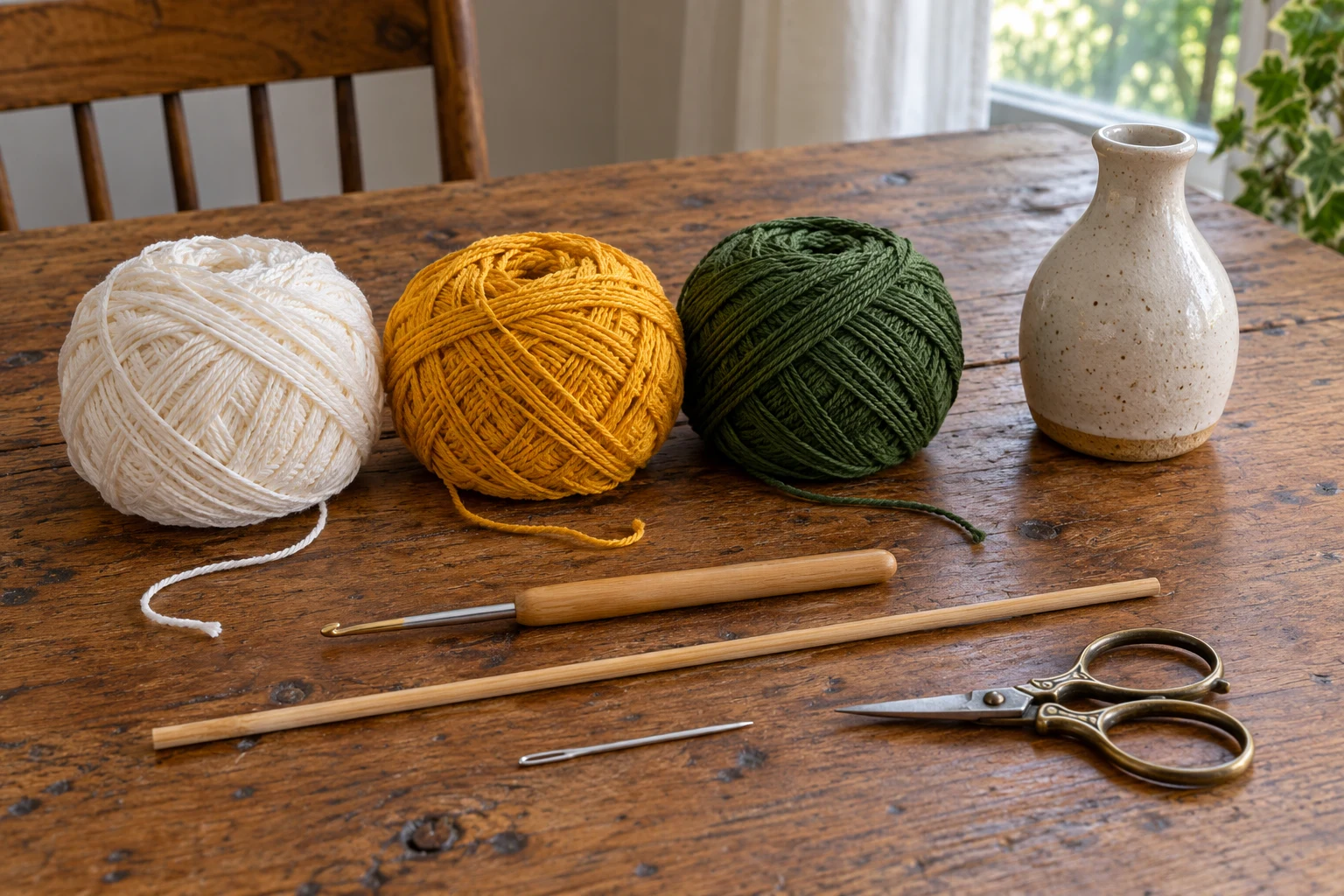
Size, Gauge, and Yarn Choices
No measured gauge or finished diameter is available for this draft. Make a petal sample and compare its flexibility with the center circle. Very tight chain tension makes short thick rays; a loose chain makes irregular loops. Use the same hook throughout a remake so all twelve petals remain comparable.
Abbreviations and Working Notes
| Abbreviation | Meaning |
|---|---|
| ch | Chain |
| sc | Single crochet |
| sl st | Slip stitch |
| st / sts | Stitch / stitches |
| MR | Magic ring |
| inc | 2 sc in the same stitch |
| dec | Invisible sc decrease; uses 2 stitches and makes 1 |
| hdc | Half double crochet |
| dc | Double crochet |
Follow US crochet terms. Chain-worked petals and leaves use both stitches and spaces; keep those units separate when counting. Joins and finishing slip stitches do not create extra petals.
Use matching yarn weights for the flower and greenery. Keep sewing tails until the parts have been pinned and their positions checked.
This supported stem is a decorative object, not a tested toy. Use only a smooth blunt support, cover both ends and check that no loose point is exposed.
The petal is worked along a new ch-5 strand: skip the chain nearest the hook, then use the four remaining chains. The anchoring slip stitch goes into the next yellow back loop, not into a white petal.
Make the Two Yellow Center Circles
| Round / stage | Instructions | Count |
|---|---|---|
| 1 | 6 sc in MR | 6 |
| 2 | Inc in every stitch | 12 |
Make two equal circles. Fasten off the back circle and leave a long sewing tail. Keep the front circle available for the white petal round. Secure the magic-ring ends inside the future center.
The twelve stitches around the front circle become the twelve petal anchors. Check that the ring is snug and the circle is smooth before adding white yarn.
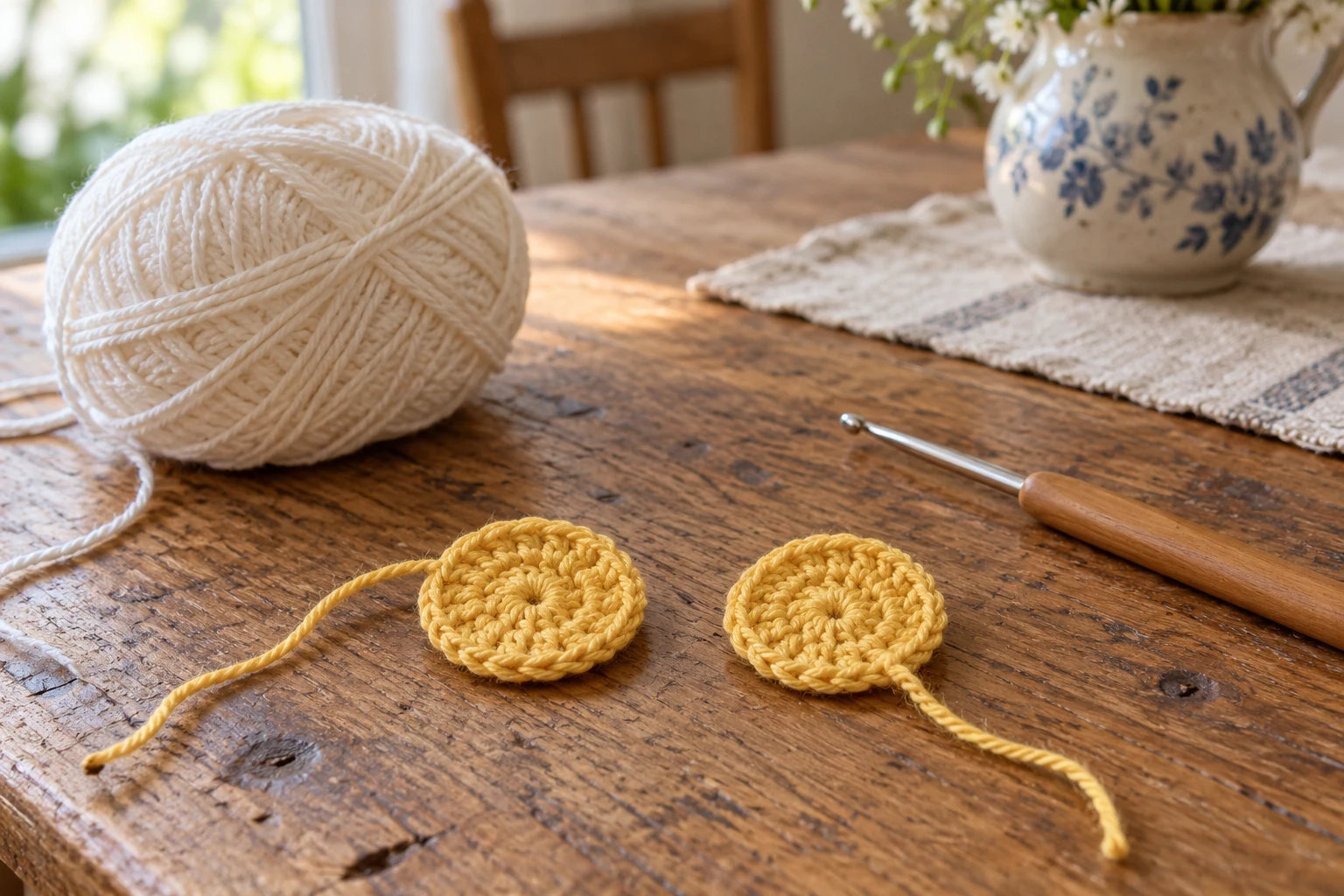
Work Twelve Narrow White Petals
| Round / stage | Instructions | Count |
|---|---|---|
| Join | Sl st white yarn into back loop of first yellow stitch | Start anchor |
| Each petal | Ch 5; sl st in second ch from hook, sc in next ch, hdc in next, dc in last ch; sl st in back loop of next yellow center stitch | 4 return stitches + anchor |
| Repeat | Make one petal per yellow base stitch; the twelfth returns to the starting anchor | 12 petals total |
There are twelve anchors around the circle. The first petal starts at Anchor 1 and finishes at Anchor 2; continue around until the last petal returns to Anchor 1. Do not add a thirteenth ray just because the start anchor is encountered again.
The return stitches graduate from slip stitch to double crochet toward the center, producing a narrow ray. Keep the ch 5 lengths even. Fasten off and secure the white tail beneath the yellow circle rather than across a visible petal.
Crochet Two Green Leaves
| Round / stage | Instructions | Count |
|---|---|---|
| Foundation | Ch 10 | 9 working chains |
| First side | From second ch: sc 1, hdc 1, dc 5, hdc 1; 3 sc in last ch | 11 stitches |
| Return side | Work underside: hdc 1, dc 5, hdc 1, sc 1; join | 8 more;19 total |
Make two leaves with long sewing tails. Flatten them with your fingers without stretching the center chain. The three stitches at the far tip let you turn to the underside; the return does not use that tip a second time.
Add hdc (half double crochet) and dc (double crochet) to your stitch vocabulary before beginning. Their height difference creates the leaf outline.
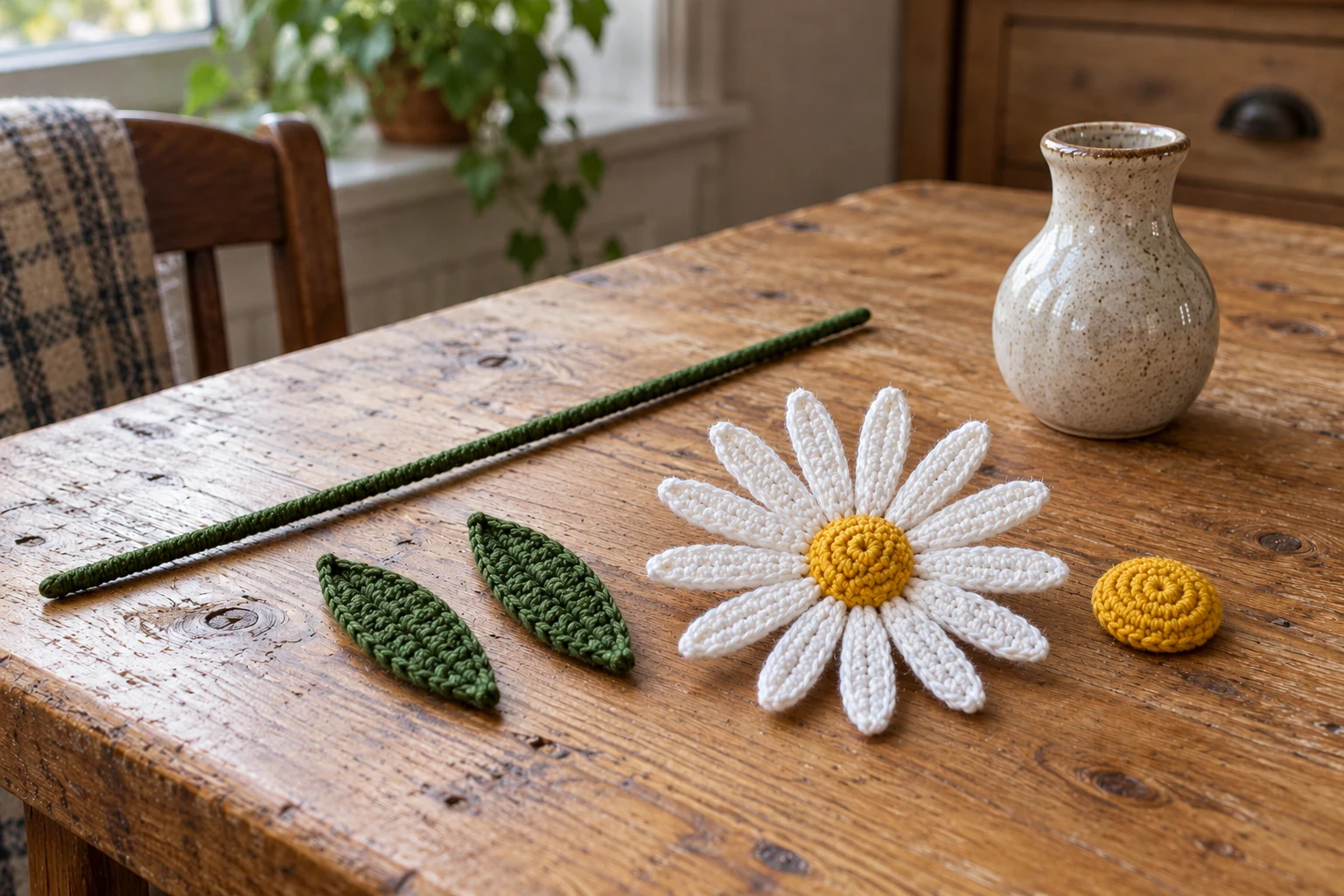
Close the Raised Center and Attach the Stem
| Round / stage | Instructions | Count |
|---|---|---|
| Center | Match the 12 back-circle stitches to the unused front loops of the yellow front | 12 positions |
| Filling | Add a tiny tuft before closing the final gap | Gentle raised disk |
| Stem | Secure covered support behind the center and attach two leaves | One complete flower |
Place the back circle behind the front with the petals outside the seam. Sew through the unused front loops of the front center and the matching back edge. Add only enough filling to raise the yellow disk slightly. Keep a small space behind the disk for the blunt support, then secure the seam around it.
Hold a green tail along the support and wrap over it closely from the flower down. Cover the upper and lower ends completely. Bind in each leaf tail at a different lower position and sew the leaf base through adjacent yarn wraps. Secure the bottom wrap with several half-hitches and weave the end under neighboring wraps.
Pin and sew the center to the wrapped top so it cannot rotate freely. This attachment needs a physical stability check; if the flower slips, remake it before display. Do not expose the wood or add an unlisted sharp wire.
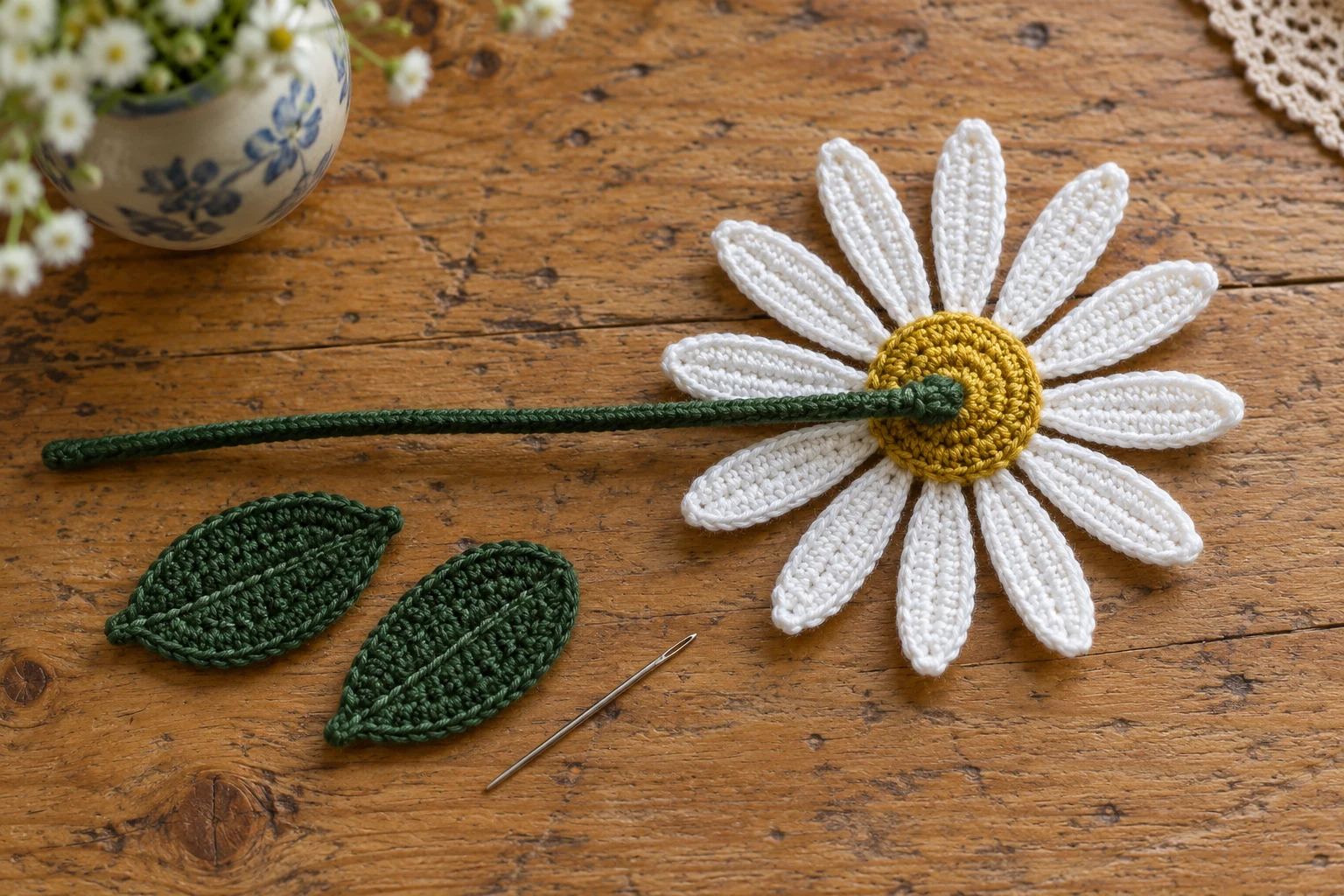
Shape the Petals and Check the Flower
| Round / stage | Instructions | Count |
|---|---|---|
| Petal count | Separate each ray gently | 12 visible petals |
| Center | Check both sides of the sewn disk | No filling exposed |
| Stem | Inspect both covered ends and leaf anchors | No loose points |
Arrange the rays radially rather than stacking them. If blocking is suitable for the cotton, test a small piece first and let it dry before final arrangement. Do not glue the petals into a shape that contradicts their construction.
Rotate the stem to inspect the reverse. A neat front is not enough if the back seam or support is loose.
Troubleshooting
| Problem | Check | Adjustment |
|---|---|---|
| Eleven or thirteen petals | Start anchor counted incorrectly | Track 12 yellow anchor positions |
| Rays vary in length | Uneven chain tension | Remake inconsistent petals |
| Center bulges strongly | Too much filling | Use a tiny tuft only |
| Leaves twist on stem | Loose base sewing | Anchor through several neighboring wraps |
Care and Related Projects
Dust gently with a soft brush. A bamboo-supported flower is not intended for machine washing. Keep it away from flame, prolonged dampness and small children who might pull off components. A single narrow vase suits the light stem.
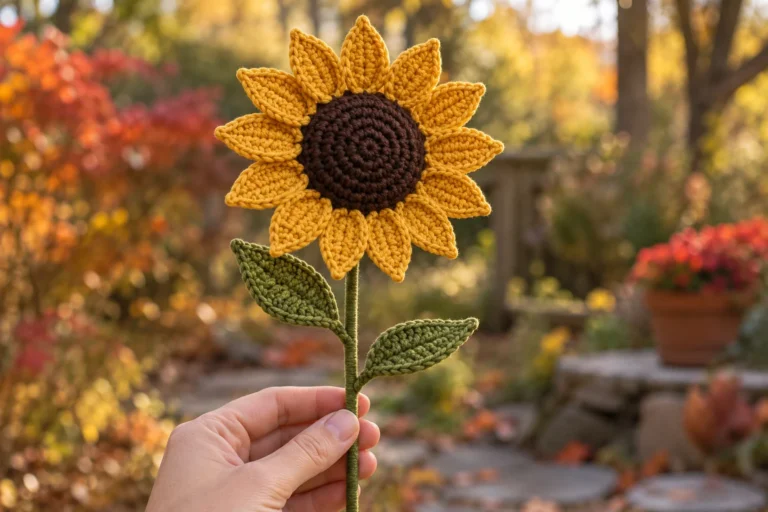
For a different flower head, see the tulip bouquet or the sunflower. Do not use their petal counts for this twelve-ray daisy.
Frequently Asked Questions
Are the petals separate pieces?
No. Each is worked from a chain and anchored to the yellow front circle in one continuous petal round.
Why use back loops for the petals?
The unused front loops provide a clearer sewing edge for the back yellow disk.
Can I leave out the stuffing?
Yes. The center will be flatter, which changes its appearance but not the 12 petal anchors.
Can it be an appliqué?
Omit the support and finish the back securely. A sewn appliqué needs its own attachment check on the intended fabric.
Does it need stiffener?
No stiffener is specified. Test yarn and tension first rather than assuming an unlisted finish is needed.
Is the size tested?
No. The stated diameter is an estimate; measure the actual sample and record its yarn and hook.
Compact Pattern Card
| Component | Essential instructions |
|---|---|
| Center | Two circles:6 then 12 |
| Petals | 12 ch 5 rays,4 return stitches each |
| Leaves | Two ch 10 ovals,19 stitches each |
| Finish | Sew raised center, cover stem, attach leaves |