Crochet Lavender Stem Pattern with Tiny Flower Clusters
Make a single crochet lavender stem with twelve small buds arranged in six pairs. Includes bud counts, leaf instructions and covered-stem assembly.
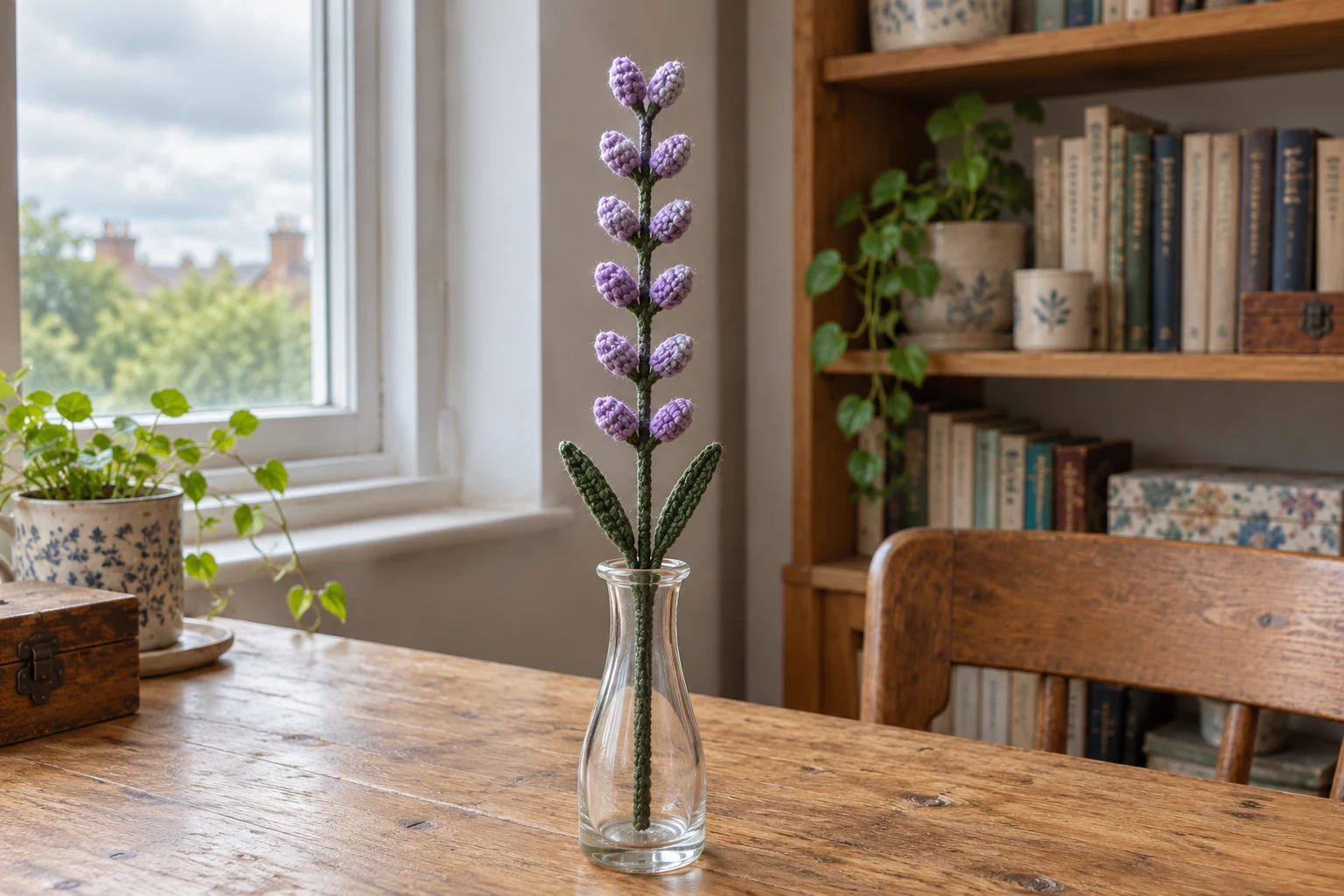
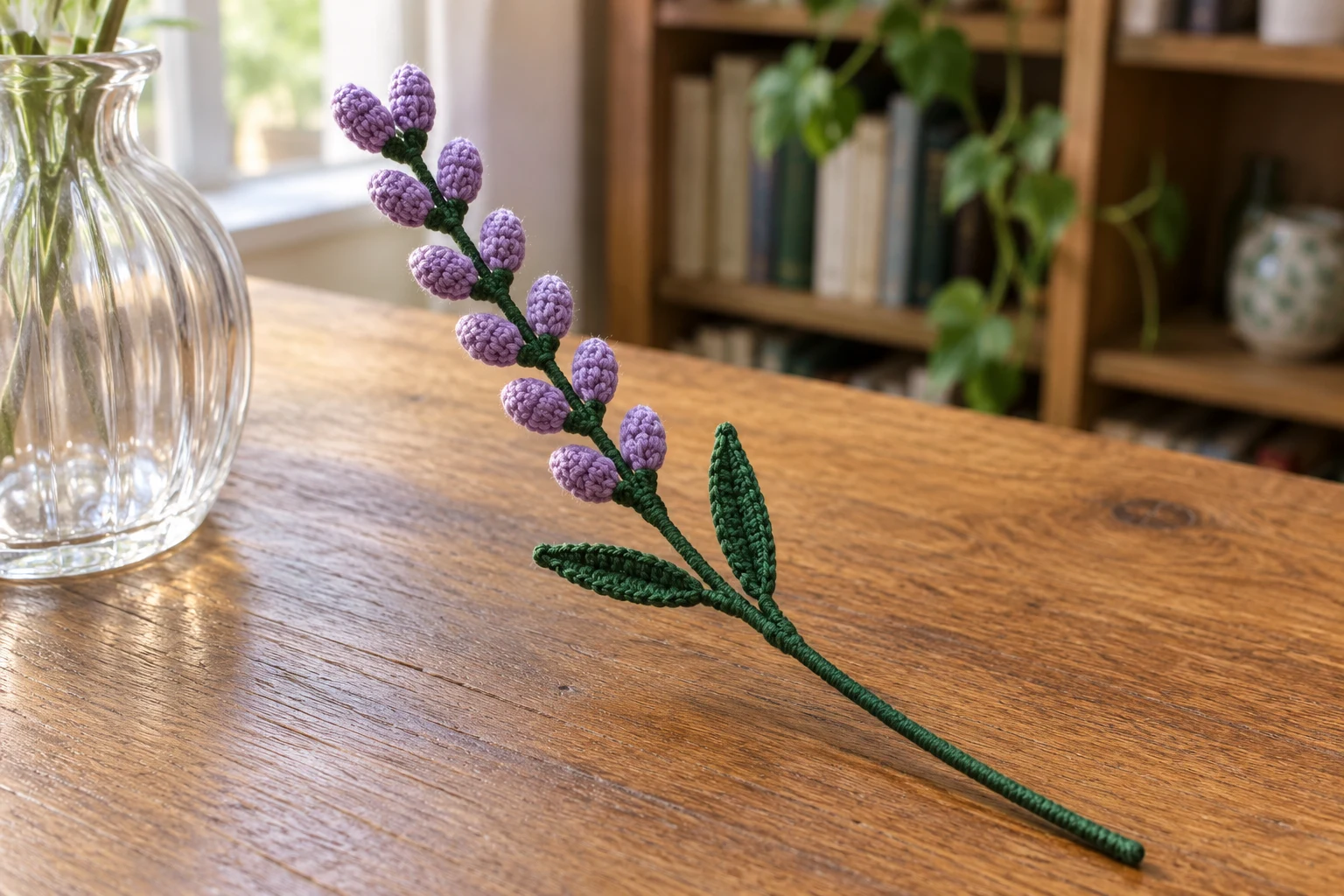
A crochet lavender stem gets its shape from repetition rather than a large petal. Twelve tiny lilac buds sit in six pairs along the upper stem, creating a narrow flower spike. Two green leaves balance the lower section.
This crochet lavender pattern uses small dense rounds for the buds and a yarn-covered blunt bamboo support. Make all twelve buds before arranging them so you can compare their sizes and avoid an uneven top-heavy cluster.
How is this project made? Make twelve small closed buds, arrange them as six opposite pairs, and sew them onto the yarn-covered upper stem. Add two leaves below the buds. The stem has no wire or plastic flower parts.
Project Overview
| Detail | Pattern information |
|---|---|
| Skill | Confident beginner comfortable with small rounds |
| Terms | US crochet |
| Hook | 2.5 mm, adjusted to yarn |
| Planning size | 20 cm stem with a flower zone about 6 cm long; unverified |
| Construction | 12 tiny buds,2 leaves, covered support |
| Testing | Count arithmetic reviewed; physical sample needed |
Illustrations and testing: These six project images are generated illustrations, not photographs of a test-crocheted sample. Counts are reviewed; sizes, yarn consumption, attachments and physical performance remain unverified.
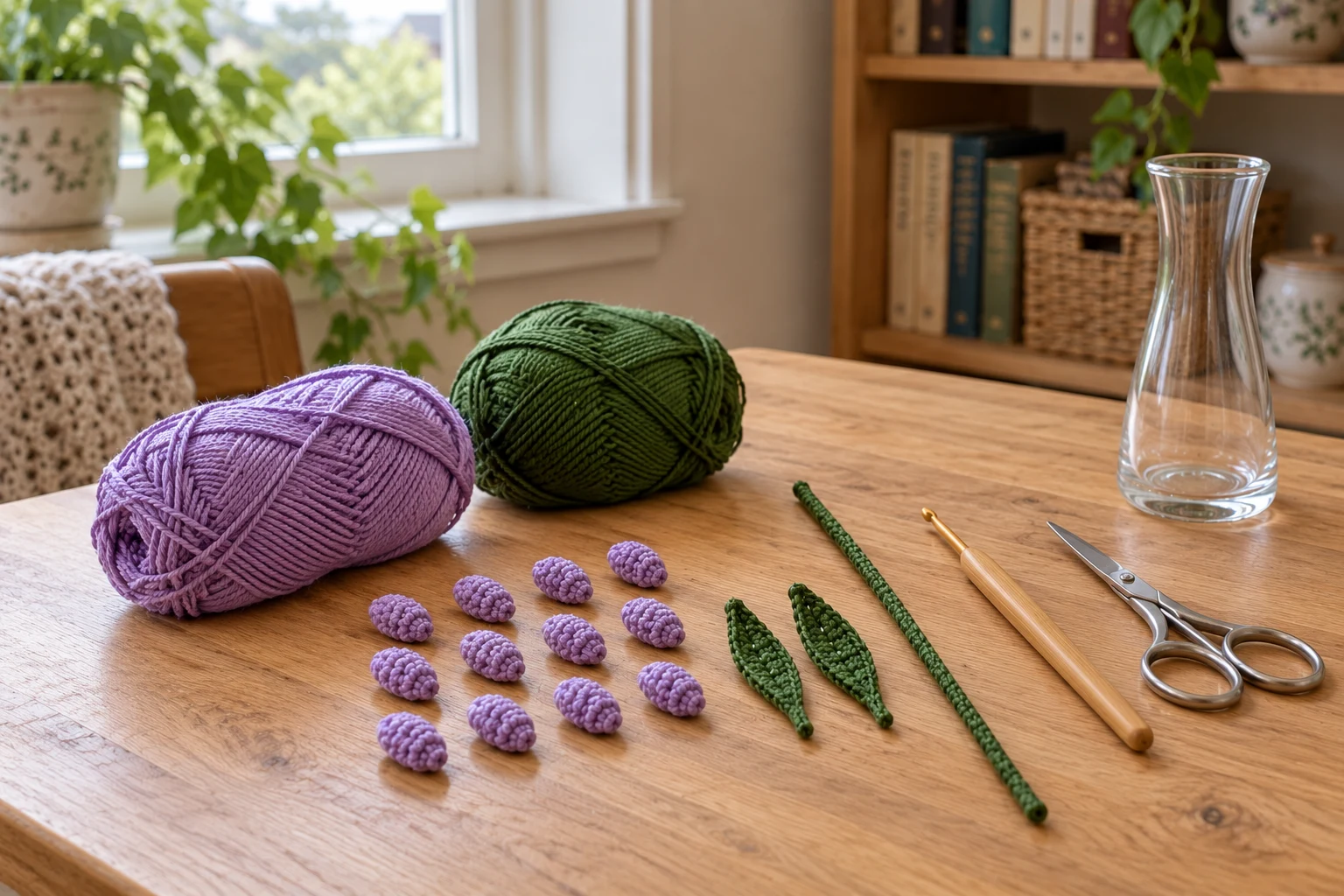
Materials
| Material | Suggested specification |
|---|---|
| Lilac cotton | Approximately 10–15 g fine/sport cotton; estimate |
| Dark green cotton | Approximately 10 g matching-weight cotton; estimate |
| Hook | 2.5 mm |
| Support | One smooth blunt bamboo dowel about 20 cm ×3 mm |
| Notions | Fine blunt needle, scissors, pins; optional tiny filling scraps |
Size, Gauge, and Yarn Choices
The buds are deliberately small, and the exact size depends strongly on yarn and tension. Make one first. It should close cleanly without a hard lump. No measured bud diameter or consumption figure is available; compare all twelve against the same first sample before sewing.
Abbreviations and Working Notes
| Abbreviation | Meaning |
|---|---|
| ch | Chain |
| sc | Single crochet |
| sl st | Slip stitch |
| st / sts | Stitch / stitches |
| MR | Magic ring |
| inc | 2 sc in the same stitch |
| dec | Invisible sc decrease; uses 2 stitches and makes 1 |
| hdc | Half double crochet |
| dc | Double crochet |
Follow US crochet terms. Chain-worked petals and leaves use both stitches and spaces; keep those units separate when counting. Joins and finishing slip stitches do not create extra petals.
Use matching yarn weights for the flower and greenery. Keep sewing tails until the parts have been pinned and their positions checked.
This supported stem is a decorative object, not a tested toy. Use only a smooth blunt support, cover both ends and check that no loose point is exposed.
Buds use continuous spiral rounds with no joining slips. Mark the first stitch. Leaves are worked around both sides of a starting chain.
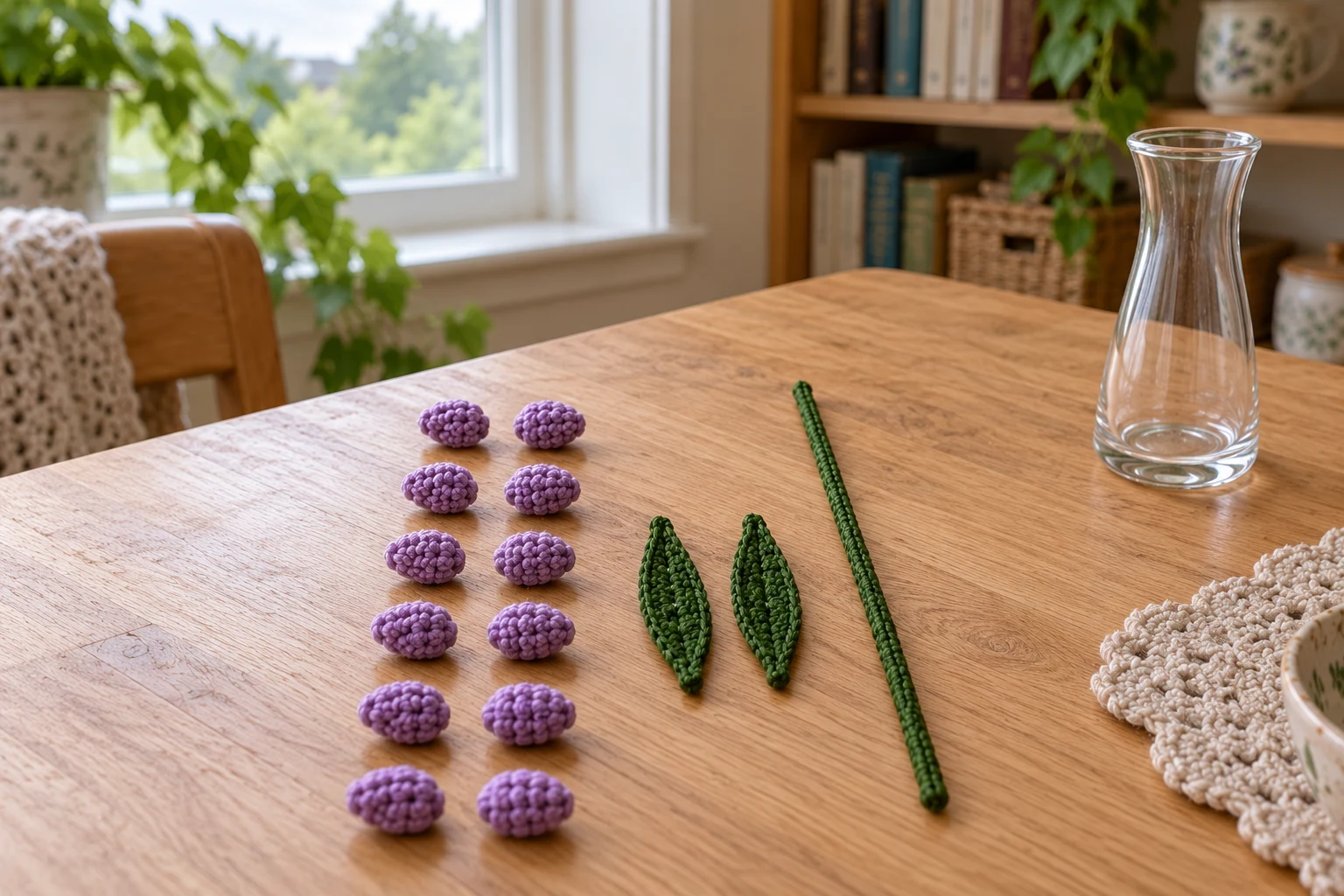
A pair contains two separate buds. Six pairs require twelve buds, not six. The green support should remain visible below the short flower zone.
Crochet Twelve Lilac Buds
| Round / stage | Instructions | Count |
|---|---|---|
| 1 | 4 sc in MR | 4 |
| 2 | Inc in every stitch | 8 |
| 3–4 | Sc around for 2 rounds | 8 each |
| 5 | Dec 4 times | 4 |
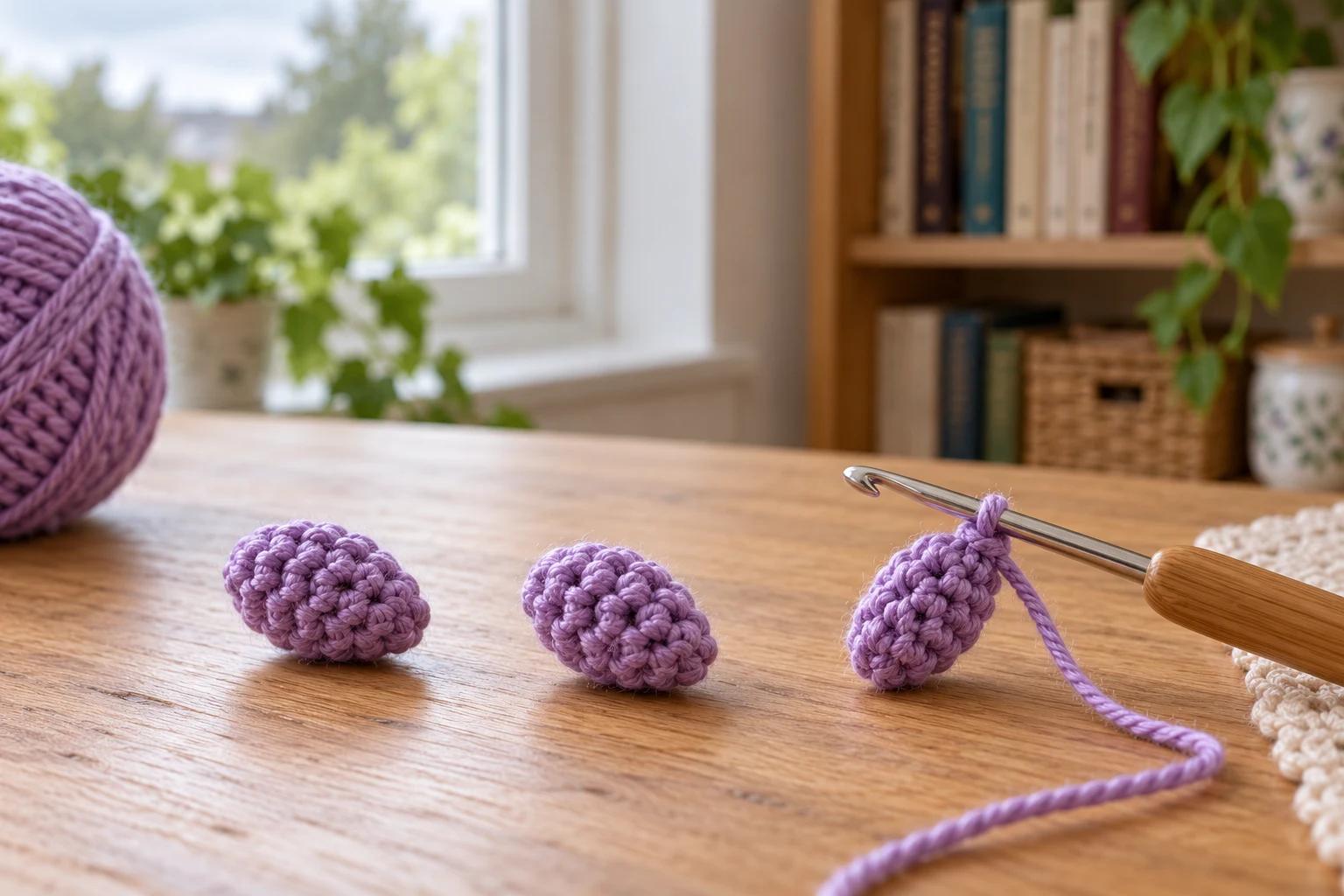
Make twelve matching buds. A tightly crocheted tiny bud may not need filling; if it collapses, add only a very small scrap before the final round. Do not force a large lump into an eight-stitch tube.
Thread the yarn through the remaining four front loops, pull closed and leave a long tail for attachment. The magic-ring end becomes the rounded visible top; the decrease closure and sewing tail sit near the stem.
Make the Two Narrow Leaves
| Round / stage | Instructions | Count |
|---|---|---|
| Foundation | Ch 10 | 9 working chains |
| First side | From second ch: sc 1, hdc 1, dc 5, hdc 1,3 sc in last ch | 11 stitches |
| Return side | On underside: hdc 1,dc 5,hdc 1,sc 1; join | 19 total around leaf |
Make two green leaves. Hdc means half double crochet and dc means double crochet. Leave a long tail at each narrow base. The return side uses eight underside positions after the three-stitch far-tip turn.
Finger-shape both leaves and compare their lengths. If they curl tightly, check the chain tension and do not stretch one to disguise a different count.
Cover the Straight Stem
| Round / stage | Instructions | Count |
|---|---|---|
| Top end | Wrap green yarn over the blunt support tip | No exposed wood |
| Main shaft | Hold starting tail along shaft and wrap closely over it | Even touching wraps |
| Bottom end | Cover tip, secure several half-hitches and weave end under wraps | No loose trailing strand |
Start at the blunt top with the yarn doubled briefly over the end, then continue down the shaft. The finished covering must not slide or leave gaps. Use a plain smooth support; do not add a pointed florist wire as a shortcut.
Leave the first six centimeters available for the bud cluster. Keep all twelve lilac sewing tails accessible until the arrangement has been checked. The physical grip of the yarn on the support must be tested on a real sample.
Arrange and Sew Six Pairs of Buds
| Round / stage | Instructions | Count |
|---|---|---|
| Pair 1 | Place two buds just below the covered top | 2 buds |
| Pairs 2–6 | Add 5 more opposite pairs, approximately 8–10 mm lower at each level | 10 further buds |
| Lower greenery | Attach 2 leaves below the bud zone at different heights | 2 leaves |
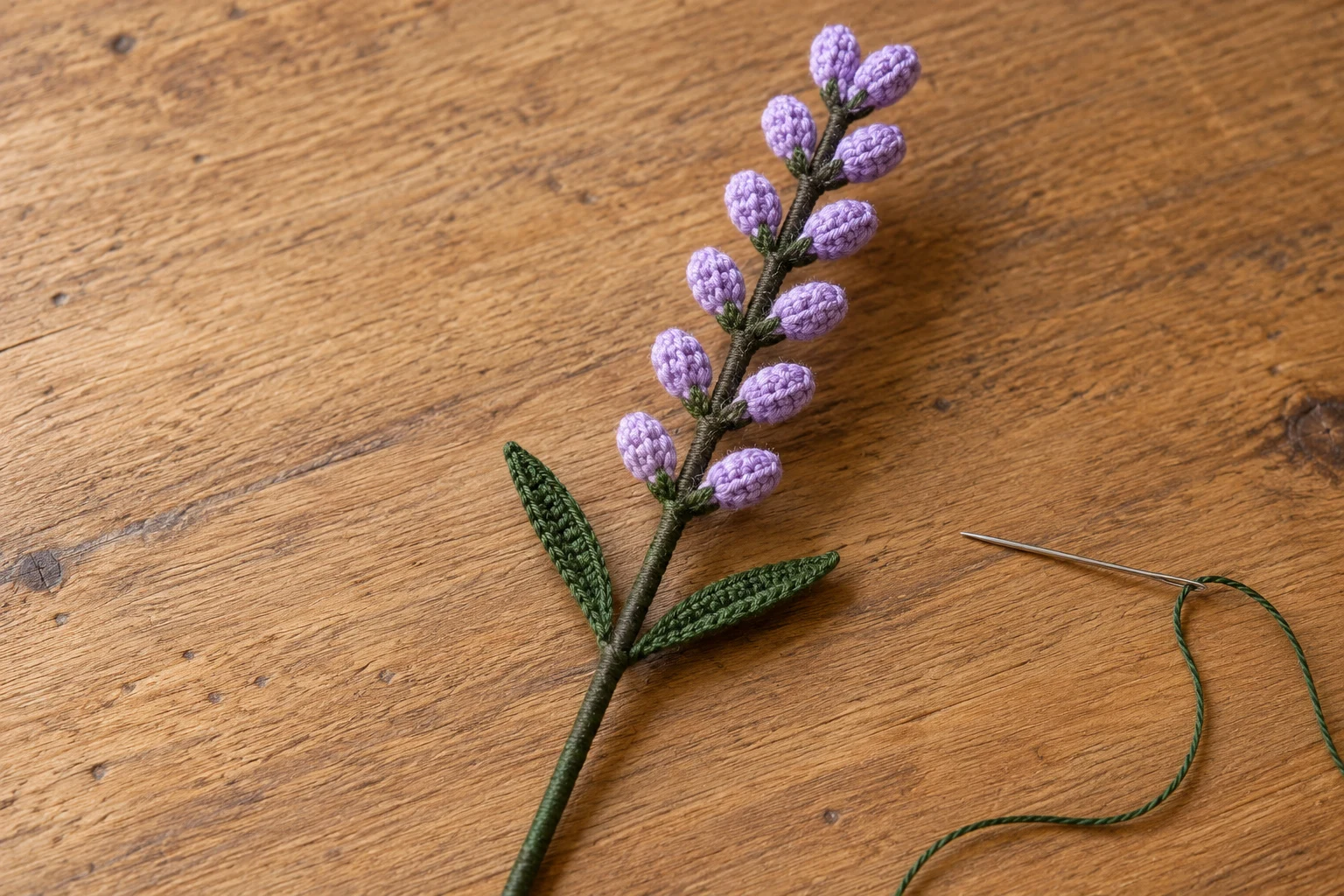
Lay the stem down and pin the buds temporarily along a narrow six-centimeter zone. Rotate alternate pairs a little so the spike is visible from several angles, rather than making one wide flat ladder. Use the same first sample to keep the spacing consistent.
Sew each bud through its closed base and several neighboring green wraps. Work around the yarn covering instead of trying to pierce bamboo. Bury the lilac tails under nearby buds and wraps without leaving long exposed loops. The head should remain slender; if all buds face one side, rebalance the pairs before securing them.
Bind and sew the two leaf bases into the green wrap below the flower zone, one slightly lower than the other. Check every bud and leaf attachment by gently moving it with your fingers. A decorative cluster is not a tested toy attachment.
Check the Finished Lavender
| Round / stage | Instructions | Count |
|---|---|---|
| Count | Six pairs, two buds per pair | 12 buds |
| Balance | Rotate the stem and inspect the spike | No bare side or heavy clump |
| Safety | Inspect covering and attachment tails | No wood tips or loose loops |
If the spike looks too bulky, reduce the amount of filling and make sure the buds are not sewn on top of one another. Do not solve a counting error by hiding an extra bud at the back.
Stand the stem in a narrow vase and check the head stays upright. The draft uses a straight support, so it should not be bent to force an arrangement.
Troubleshooting
| Problem | Check | Adjustment |
|---|---|---|
| Buds differ in size | Mixed tension or extra rounds | Compare all with first sample |
| Flower head is too wide | Pairs face the same flat plane | Rotate alternate pairs slightly |
| Stem covering slips | Wraps too loose | Rewrap and secure before assembly |
| A bud rotates freely | Attachment only catches one strand | Sew through several stable wraps |
Care and Related Projects
Brush off dust gently and avoid soaking the supported stem. Store it flat when not displayed so leaves are not crushed. The yarn flower has no natural lavender scent; do not imply otherwise or add oils that may stain the cotton.
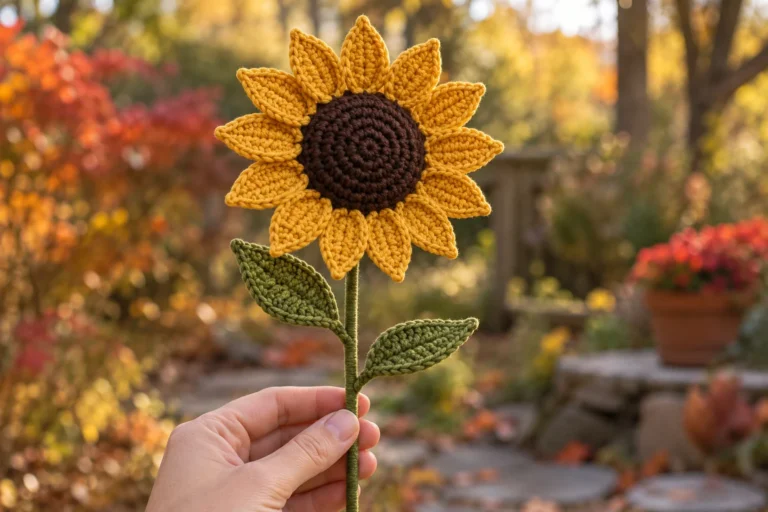
For a broader flower head, see the crochet sunflower. Use this page’s twelve-bud arrangement rather than adapting its separate-petal construction.
Frequently Asked Questions
How many buds are needed?
Twelve: six pairs of two. Count the pieces before sewing.
Can I use variegated lilac yarn?
Yes, if it remains the same weight and all buds keep comparable dimensions. Check the visual balance before attaching them.
Are the buds stuffed?
They may hold their shape without filling. Use only a tiny scrap if needed; a tightly packed bud becomes oversized.
Can I make three stems?
Repeat the complete twelve-bud stem three times and measure the actual yarn use; the estimates are for one stem.
Does the stem bend?
No. This version uses a straight blunt bamboo support rather than a flexible wire.
Is it washable?
It is a supported decoration, not a machine-washable tested sample. Gentle dusting is the practical starting method.
Compact Pattern Card
| Component | Essential instructions |
|---|---|
| Buds | 12 pieces:4,8,8,8,4 stitches |
| Leaves | 2 chain-worked ovals,19 stitches each |
| Stem | Covered blunt 20 cm support |
| Assembly | Six opposite pairs over upper 6 cm; leaves below |