Crochet Lunch Bag Pattern with a Flat Base and Fold-Over Top
Make an olive crochet lunch sack with a fold-over button top and removable cotton liner. Includes flat panels, corner seams and liner measurements.
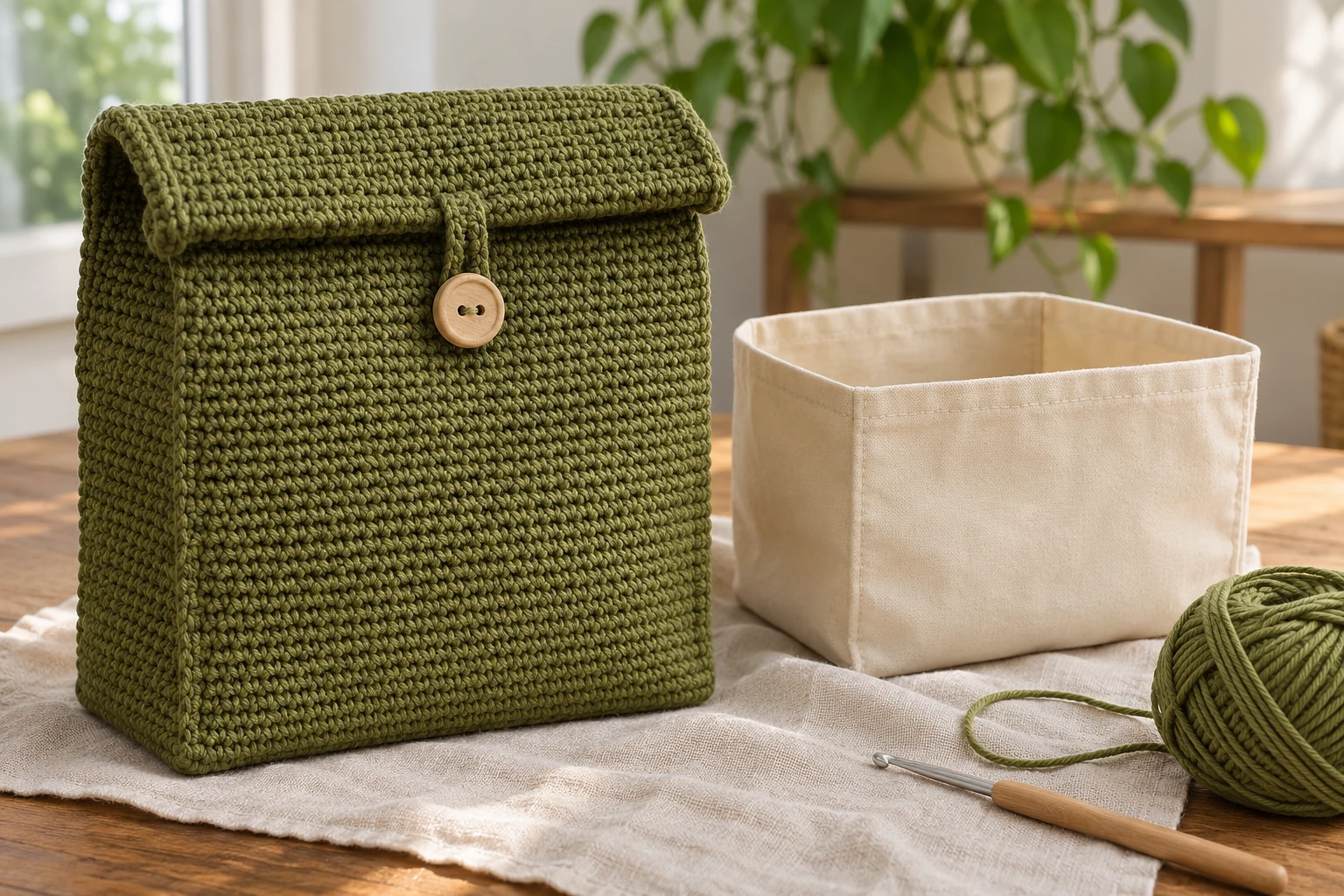
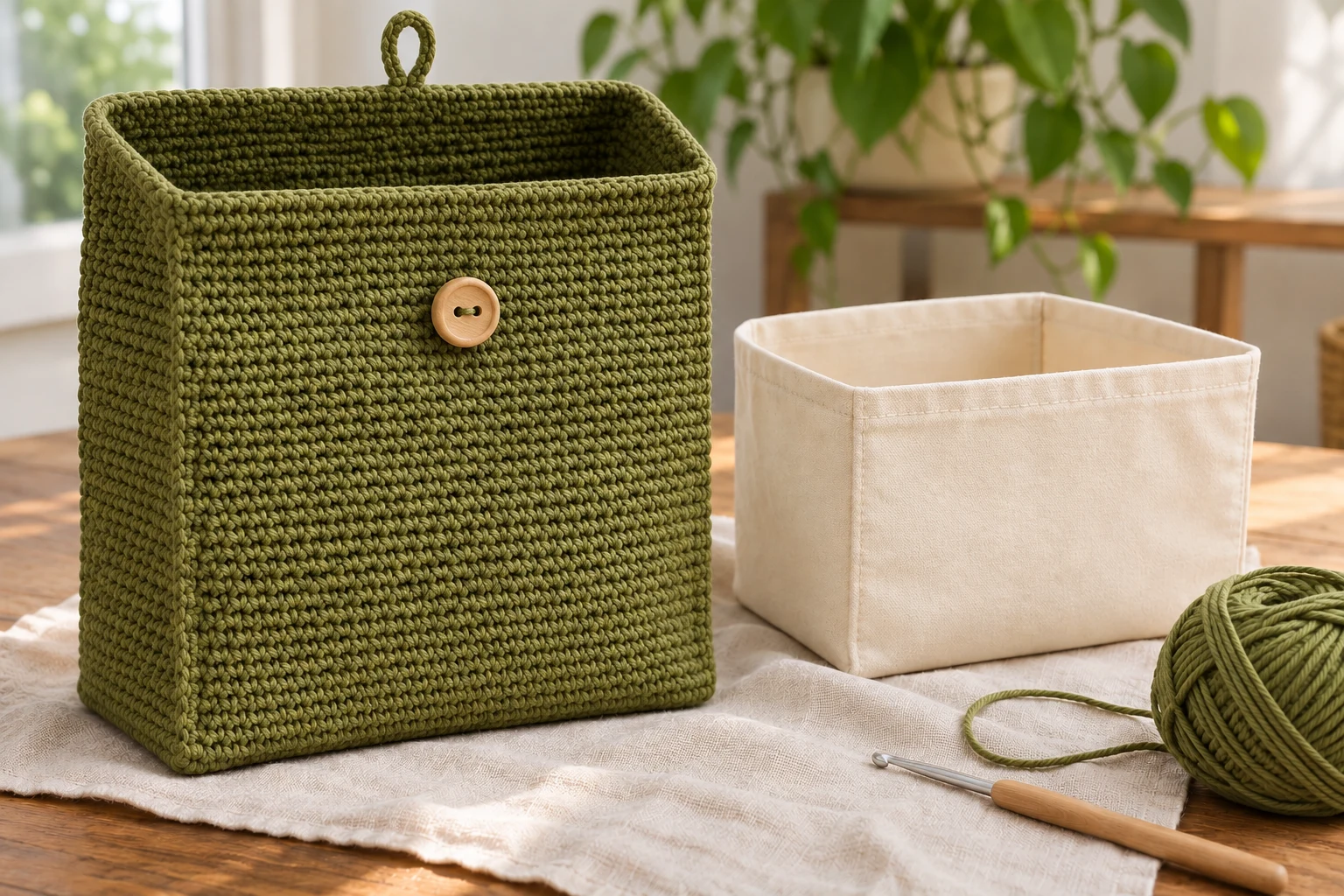
This olive crochet lunch sack uses five dense rectangular panels and a soft fold-over top. A small wooden button and yarn loop hold the fold. A separate washable cotton fabric liner fits the lower pocket and lifts out for cleaning; neither layer is an insulated or leakproof barrier.
Make two thirty-stitch front and back panels, two twelve-stitch sides and a thirty-stitch by twelve-row base. Seam the lower corners, fit a folded top and button loop, then measure the assembled interior for a removable five-panel fabric liner.
Project Overview
| Detail | Information |
|---|---|
| Terms | US crochet |
| Skill | Confident beginner with sewing |
| Construction | Make two thirty-stitch front and back panels, two twelve-stitch sides and a thirty-stitch by twelve-row base. Seam the lower corners, fit a folded top and button loop, then measure the assembled interior for a removable five-panel fabric liner. |
| Testing | Arithmetic reviewed; physical sample not tested |
Project views are generated illustrations of the intended construction. Sizes, yarn use and attachment performance remain unverified on a physical sample.
Materials
| Material | Suggested specification |
|---|---|
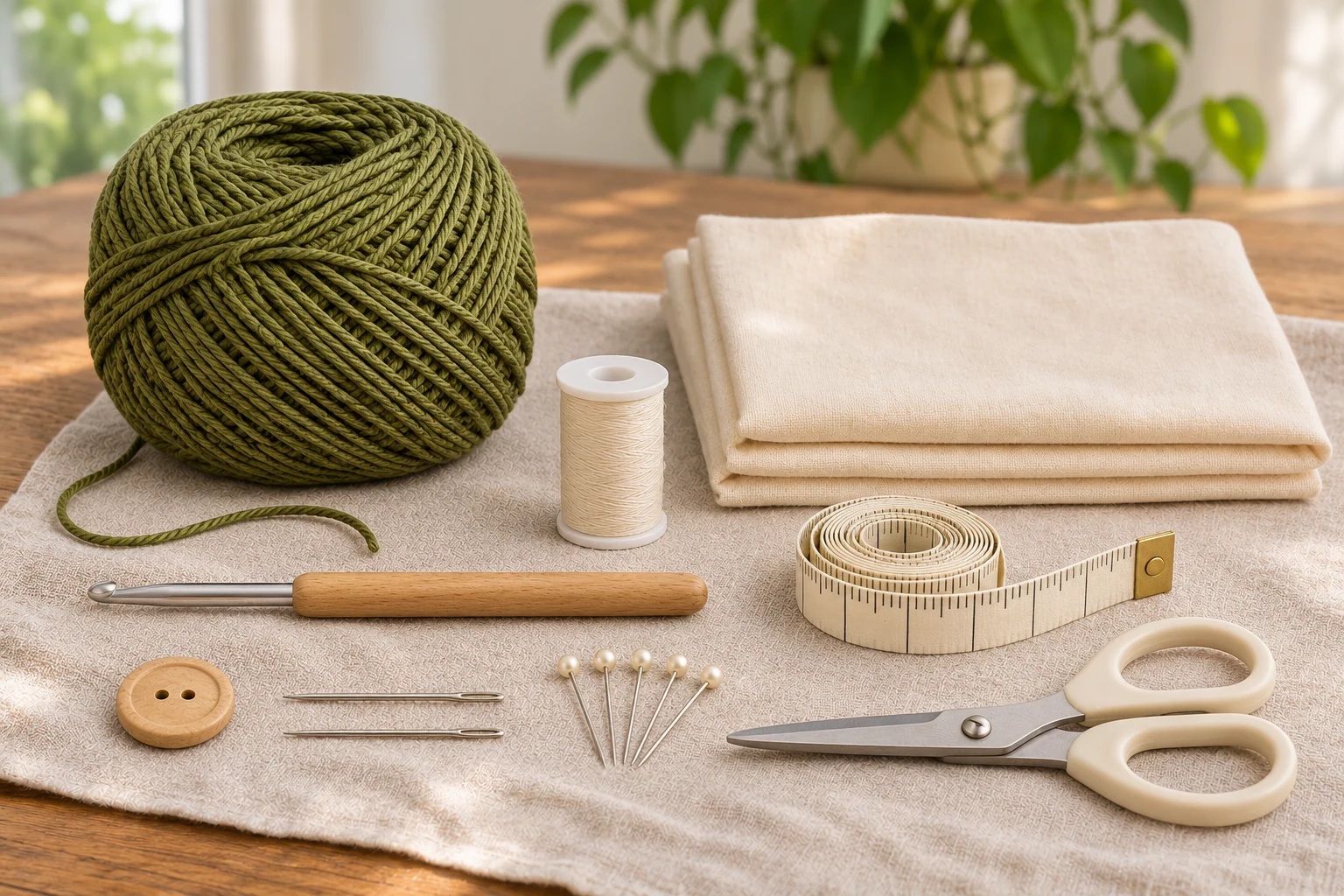
| Yarn | About 150–200 g olive worsted cotton; estimate |
| Hook | 4 mm or size giving dense flexible sc |
| Closure | One smooth sew-on wooden button and matching strong thread |
| Liner | Prewashed plain washable cotton fabric, matching thread and sewing needle or machine |
| Tools | Yarn needle, pins, markers, tape measure and scissors |
Size and Gauge
At a planning gauge of 20 sc and 20 rows per 10 cm, the crochet shell is about 15 cm wide, 6 cm deep and 15 cm high before folding. Folding the top approximately 5 cm leaves about 10 cm of lower storage height. These are calculations, not measured sample dimensions or a promised container fit. Measure the actual inside after seams before cutting the liner.
Abbreviations and Working Notes
| Term | Meaning |
|---|---|
| ch | Chain |
| sc | Single crochet |
| sl st | Slip stitch |
| inc | 2 sc in one stitch |
| dec | Invisible sc decrease over 2 stitches |
| MR | Magic ring |
| dc | Double crochet |
US terms. Work turned sc rows with ch 1 excluded from stitch counts. All four upright panels have thirty rows so vertical seams can align row for row.
The liner is a removable sewn box, not a crocheted second bag. It must stop below the fold line rather than being trapped by the button or stitched permanently into the shell.
Use closed food containers appropriate for the contents. This cotton carrier has no established thermal, waterproof or food-contact performance. No handles, straps or zipper are included.
Crochet Four Upright Panels
| Round / stage | Instructions | Count / check |
|---|---|---|
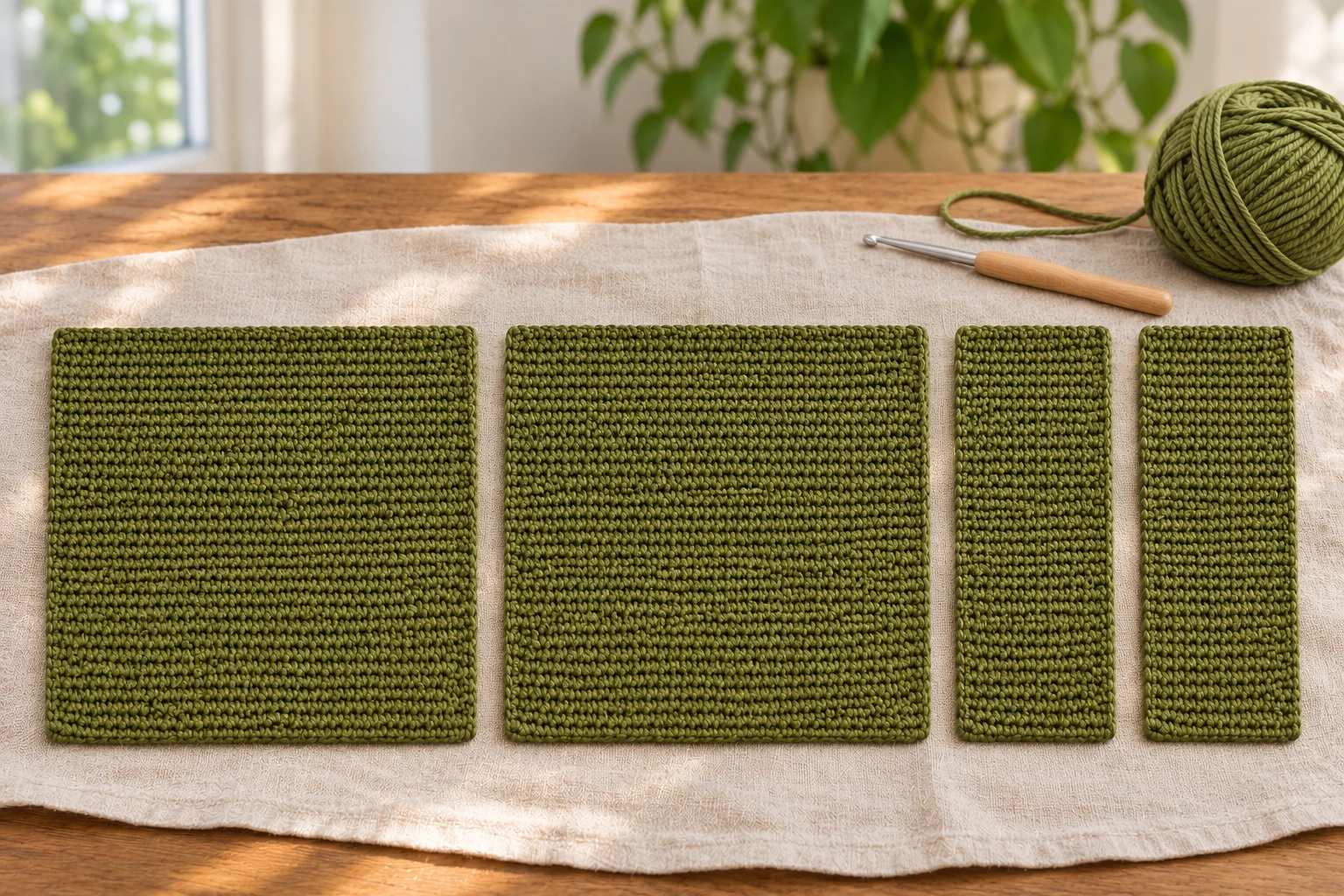
| Front and back Row 1 | Olive: ch 31; sc in second and across | 30; make two |
| Front/back Rows 2–30 | Ch 1, turn; sc across | 30 each |
| Each side Row 1 | Ch 13; sc in second and across | 12; make two |
| Side Rows 2–30 | Ch 1, turn; sc across | 12 each |
Mark the top and foundation edges of every piece. Rest or block the panels before measuring, keeping the front pair and side pair together. Mark a tentative fold line ten rows below each upper edge. This is a fitting reference, not an extra seam or a rigid crease.
Make and Join the Flat Base
| Round / stage | Instructions | Count / check |
|---|---|---|
| Base Row 1 | Ch 31; sc in second and across | 30 |
| Base Rows 2–12 | Ch 1, turn; sc across | 30 each |
| Long edges | Join front/back foundations to base long edges | 30 matched pairs each |
| Short edges | Fit twelve side foundation stitches across twelve base row ends | One evenly distributed seam each |
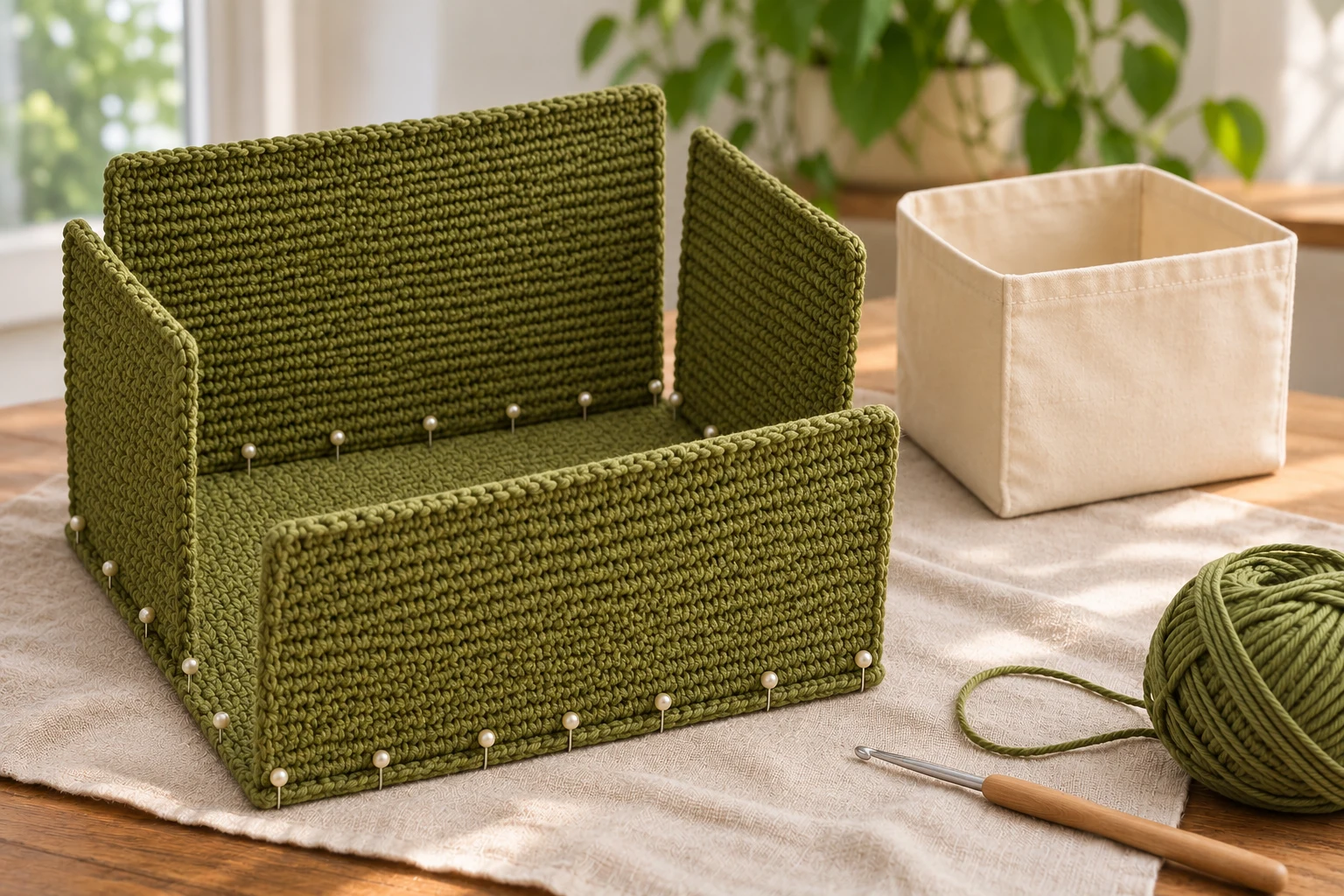
Pin all four base corners together before sewing. At the planning square gauge, twelve row ends and twelve side stitches have similar lengths; compare the actual fabric before committing. Sew through supported edge fabric and reinforce the corners without creating tight knots.
Close Four Vertical Corners
| Round / stage | Instructions | Count / check |
|---|---|---|
| Sides | Match each thirty-row side edge to corresponding front/back edge | 30 row-end pairs |
| Quantity | Sew four vertical joins | Mouth stays open |
| Fit | Check lower pocket against intended closed container | No forced stretching |
Keep all four top edges free. Support the lower bag on a flat surface while checking that the corners sit at the same height. Remove temporary pins and bury yarn ends before fitting the top closure. Dense fabric can still stretch; no carrying strength has been established.
Fit Fold, Button and Loop
| Round / stage | Instructions | Count / check |
|---|---|---|
| Fold | Flatten side fabric inward and lower top toward front | About ten rows as starting fold |
| Loop | Ch 12; sl st back eleven chains | Fit actual button circumference |
| Button | Sew to front at relaxed loop landing point | Broad thread support |
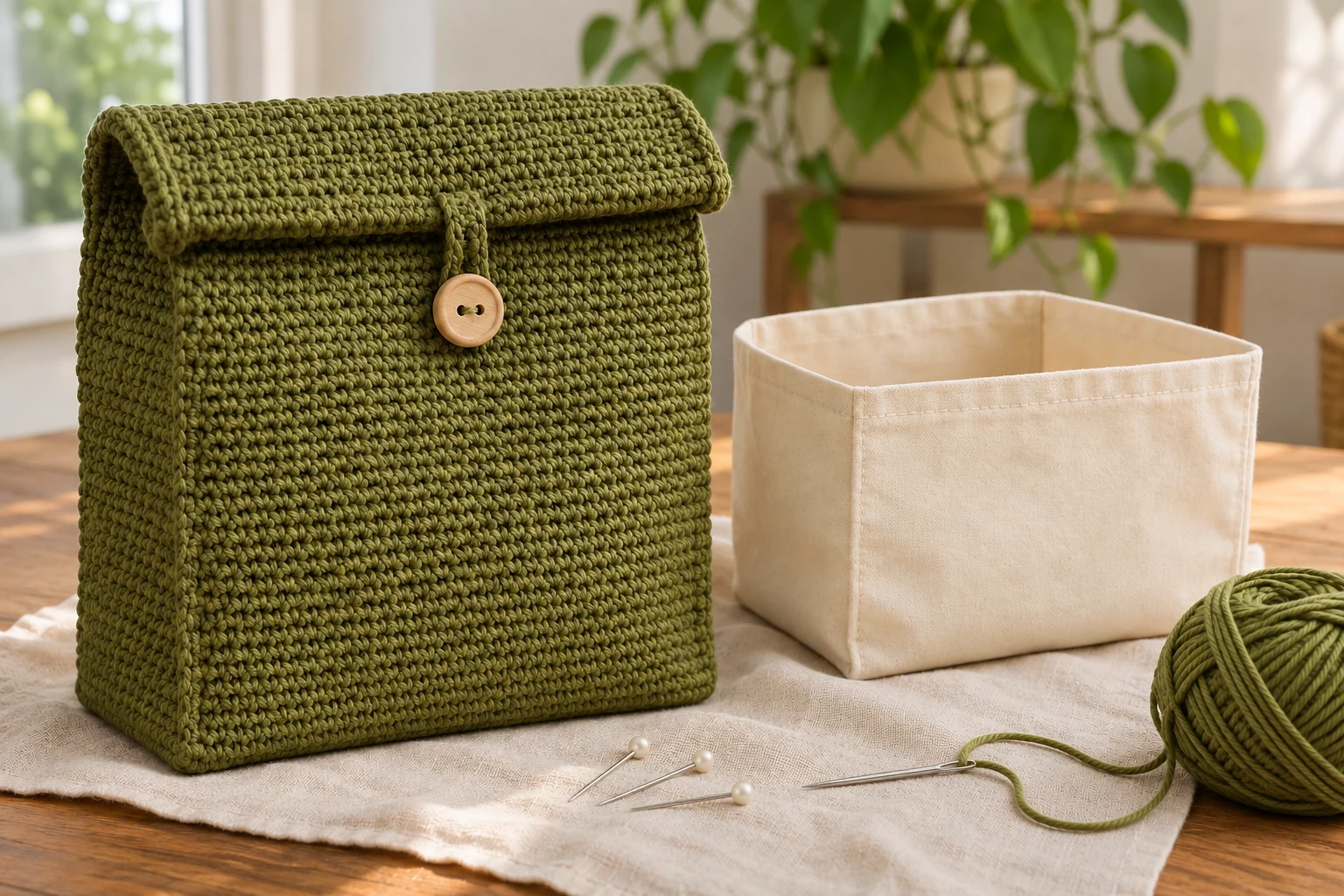
Pin the loop roots to the folded upper edge and test it around the actual button before sewing. Adjust chain count if necessary; the loop must pass over the button without pulling the fold tight. Put intended light contents inside, lower the top naturally and mark the button landing point. Sew its holes into several neighboring crochet stitches and keep the inside free of long thread floats. The top is folded, not sealed.
Measure and Sew a Removable Liner
| Round / stage | Instructions | Count / check |
|---|---|---|
| Measure | Record actual inside width W, depth D and lower height H below fold | Leave modest insertion clearance |
| Front/back cuts | W + 2 s wide by H + s + h high | Two pieces |
| Side cuts | D + 2 s wide by H + s + h high | Two pieces |
| Base cut | W + 2 s by D + 2 s | One piece |
Prewash the fabric according to its label before measuring. Here s is the chosen seam allowance and h the total fabric consumed by a double-fold top hem; for example s may be 0.7 cm and h 1.5 cm. Those are construction choices, not additions to the finished cavity. Sew four side panels around the base with right sides together, then sew the four vertical corners. Finish raw seam edges with a suitable stitch or enclosed finish and turn to the intended inside orientation. Fold and sew the top hem using the recorded h. Check the empty liner fits easily and lifts out without catching the closure. Do not sew it into the crochet shell.
Check the Complete Sack
| Round / stage | Instructions | Count / check |
|---|---|---|
| Liner | Top remains below fold and button roots | Removes freely |
| Closure | Loop passes over button without stretching | Fold stays relaxed |
| Base | Closed container sits without bowing corners | No leakproof claim |
Try the complete arrangement over a table. If the liner is tight, resize it rather than forcing its seams against the crochet corners. The shell and liner both need physical fit checks before regular use. Remove the liner for cleaning and dry both layers fully before reassembly.
Troubleshooting
| Problem | Likely cause | Adjustment |
|---|---|---|
| Liner bunches at fold | Finished height too tall | Measure below fold line |
| Base twists | Side lengths mismatched | Pin all four corners before sewing |
| Loop too tight | Button size not fitted | Adjust chain count |
| Fold pulls open | Contents too tall | Use smaller closed container |
Care and Related Projects
Follow the cotton yarn, fabric and wooden-button care instructions separately. Remove the liner before washing, reshape the shell and dry both fully. Inspect corner and button stitching after cleaning.
For another useful construction reference, see this related crochet project. Its stitch counts and attachment positions belong to that project; keep the instructions for this design separate.
Frequently Asked Questions
Is this insulated?
No insulation is specified or tested.
Is the liner sewn into the bag?
No. It is a separate removable five-panel fabric box.
Does the top roll?
The soft upper section folds down toward the front and is held by a fitted loop and button.
Are handles included?
No. This version has a simple folded lunch-sack silhouette.
Compact Pattern Card
| Stage | Key instruction |
|---|---|
| Crochet Four Upright Panels | Ch 1, turn; sc across |
| Make and Join the Flat Base | Fit twelve side foundation stitches across twelve base row ends |
| Close Four Vertical Corners | Check lower pocket against intended closed container |
| Fit Fold, Button and Loop | Sew to front at relaxed loop landing point |
| Measure and Sew a Removable Liner | W + 2 s by D + 2 s |
| Check the Complete Sack | Closed container sits without bowing corners |