Crochet Mini Duffle Bag Pattern with Circular Ends
Crochet a lavender mini barrel duffle with circular ends, a long zipper and two cotton-webbing handles. Includes circumference fitting and seams.
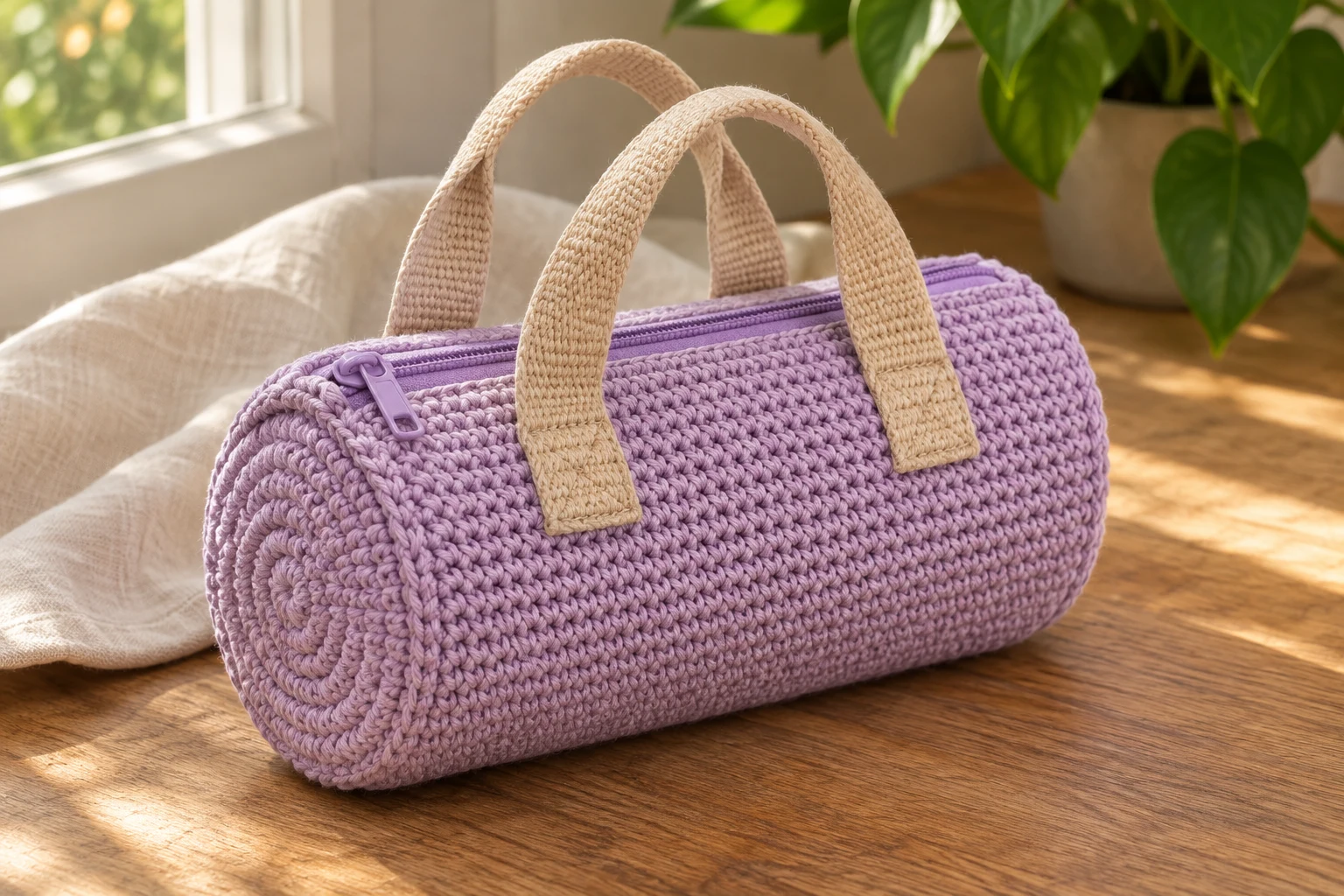
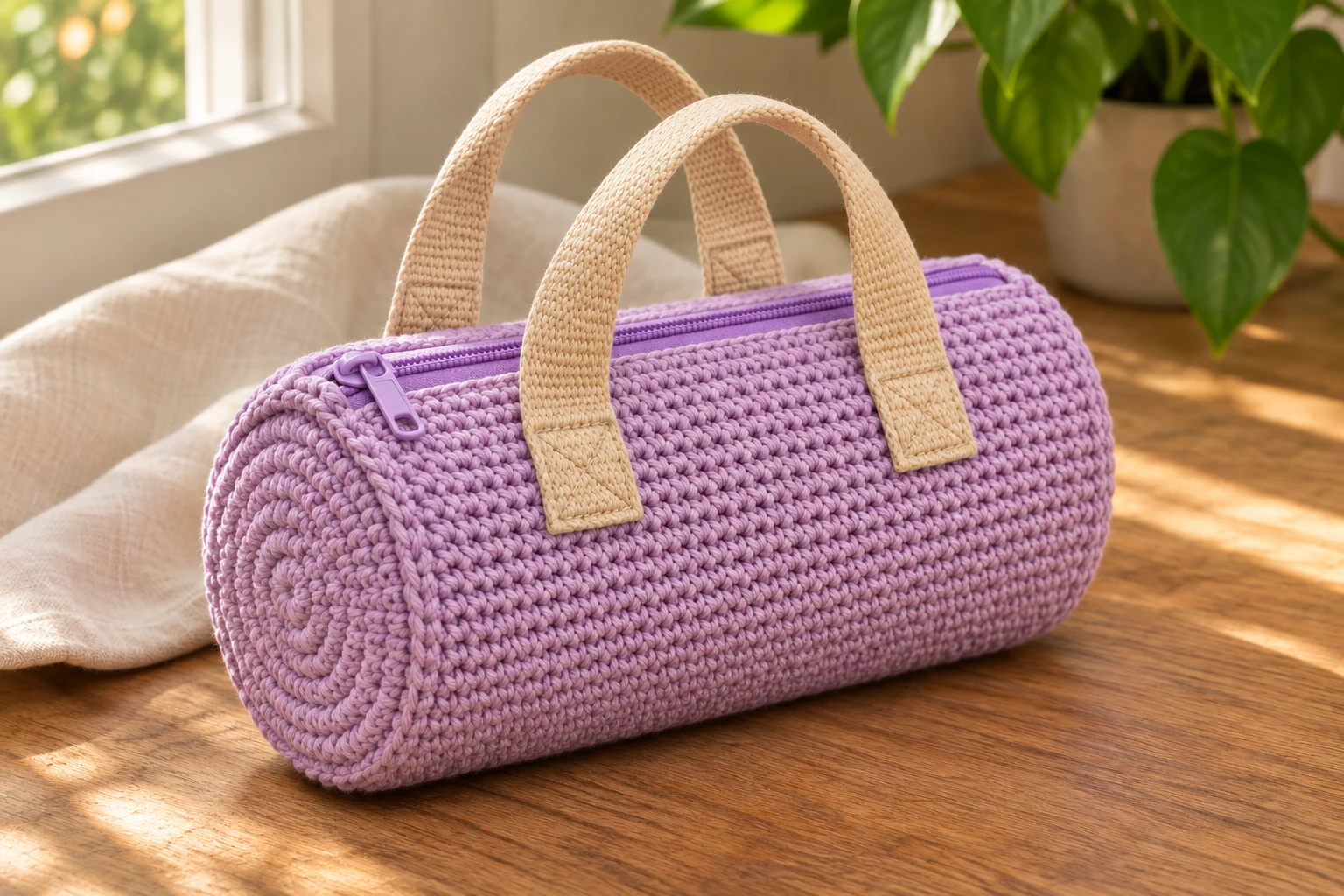
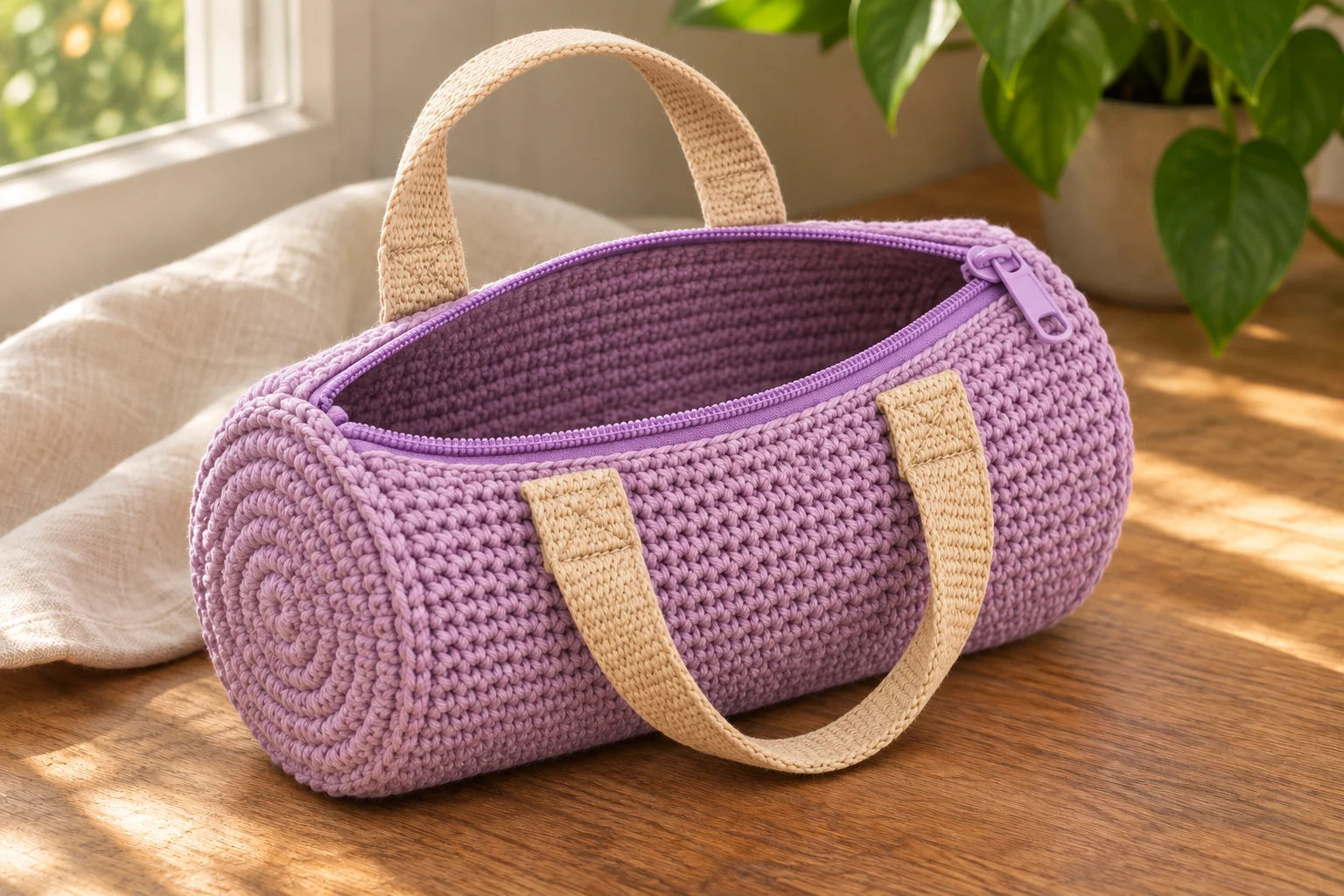
This lavender mini duffle has two round ends and one rectangular wrap panel, with a long zipper along its upper opening. Two short tan cotton-webbing handles are sewn across broad areas of the crochet fabric. The round ends create the barrel profile without a rigid insert.
Make two forty-eight-stitch circular ends and a forty-stitch by forty-eight-row body rectangle. Fit a zipper between the two long stitch edges, then sew each forty-eight-row side around one circular rim. Fit two webbing handles with broad overlaps, checking access to the zipper before sewing.
Project Overview
| Detail | Information |
|---|---|
| Terms | US crochet |
| Skill | Confident beginner with sewing |
| Construction | Make two forty-eight-stitch circular ends and a forty-stitch by forty-eight-row body rectangle. Fit a zipper between the two long stitch edges, then sew each forty-eight-row side around one circular rim. Fit two webbing handles with broad overlaps, checking access to the zipper before sewing. |
| Testing | Arithmetic reviewed; physical sample not tested |
Project views are generated illustrations of the intended construction. Sizes, yarn use and attachment performance remain unverified on a physical sample.
Materials
| Material | Suggested specification |
|---|---|
| Cotton | About 150–200 g lavender worsted cotton; estimate |
| Hook | 4 mm or size giving dense flexible fabric |
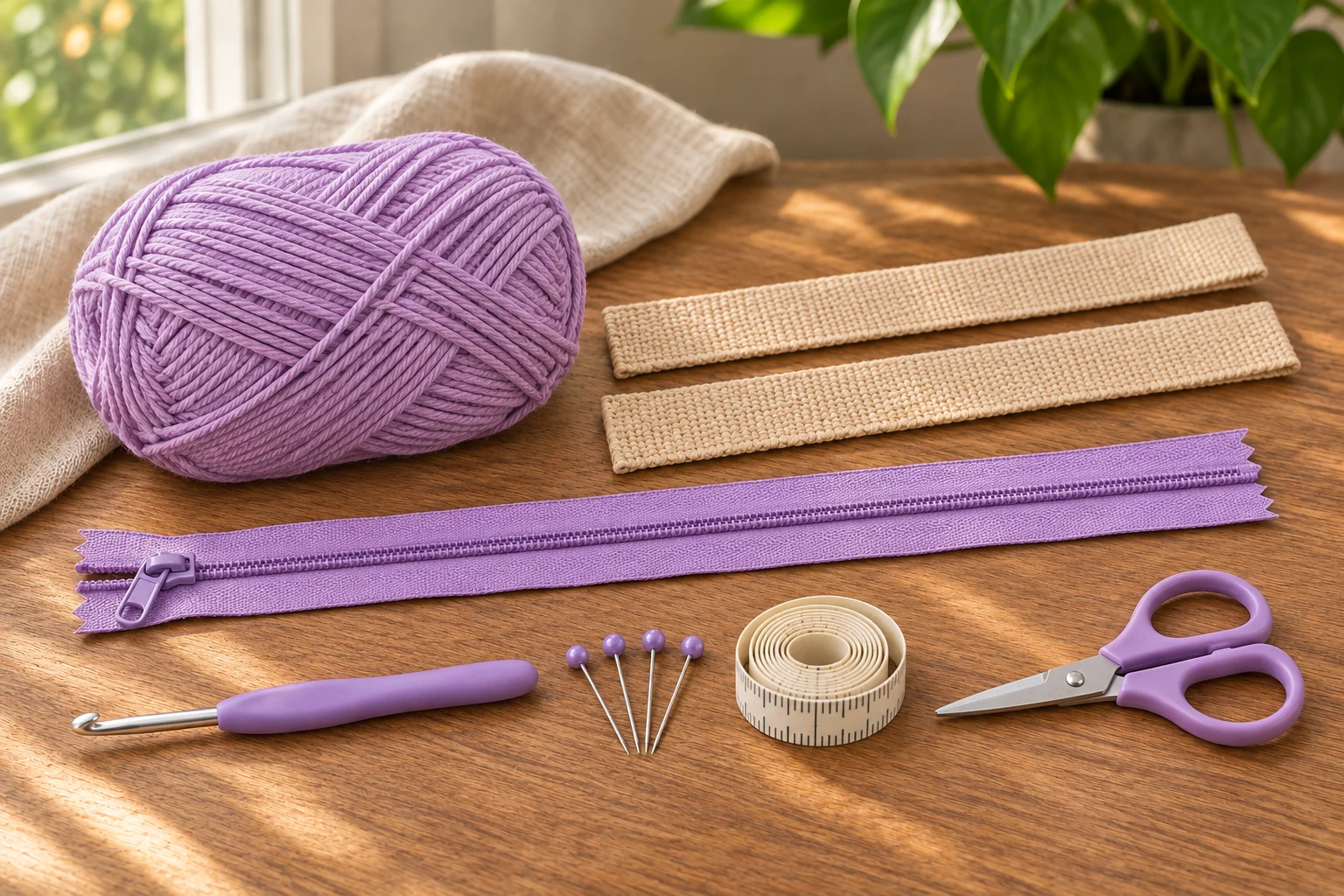
| Closure | One flexible lavender nylon zipper fitted to the actual long opening, about 20 cm as a starting estimate |
| Handles | Two lengths of 10–15 mm tan cotton webbing, cut after fitting handle rise and overlaps |
| Tools | Needles, strong matching sewing thread, markers, pins, tape measure and scissors |
Size and Gauge
The planning gauge is 20 sc and 20 rows per 10 cm. Forty stitches give a body length of about 20 cm; forty-eight rows give a wrap circumference around 24 cm. A forty-eight-stitch circle rim at that stitch gauge also measures about 24 cm around, suggesting a diameter near 7.6 cm. These are calculations, not sample measurements. Crochet circles, seams and zipper tape affect the final fit; compare the actual pieces before sewing.
Abbreviations and Working Notes
| Term | Meaning |
|---|---|
| ch | Chain |
| sc | Single crochet |
| sl st | Slip stitch |
| inc | 2 sc in one stitch |
| dec | Invisible sc decrease over 2 stitches |
| MR | Magic ring |
| dc | Double crochet |
US terms. Body rows turn with ch 1 excluded. Circle rounds join with sl st and ch 1 excluded. A matched row/stitch gauge matters because the forty-eight body row ends meet forty-eight circle stitches.
The body rectangle wraps around the barrel, while its two forty-stitch edges meet at the zipper. Do not sew those edges closed as a solid seam.
Webbing handles are sewn to dense crochet fabric; there is no tested load rating. No shoulder strap, metal rings, lining or stiffener is specified.
Crochet Two Circular Ends
| Round / stage | Instructions | Count / check |
|---|---|---|
| 1 | Lavender: 6 sc in MR; join | 6 |
| 2 | Inc around; join | 12 |
| 3–8 | Round n: ((n−2) sc, inc) × 6; join | 18, 24, 30, 36, 42, 48 |
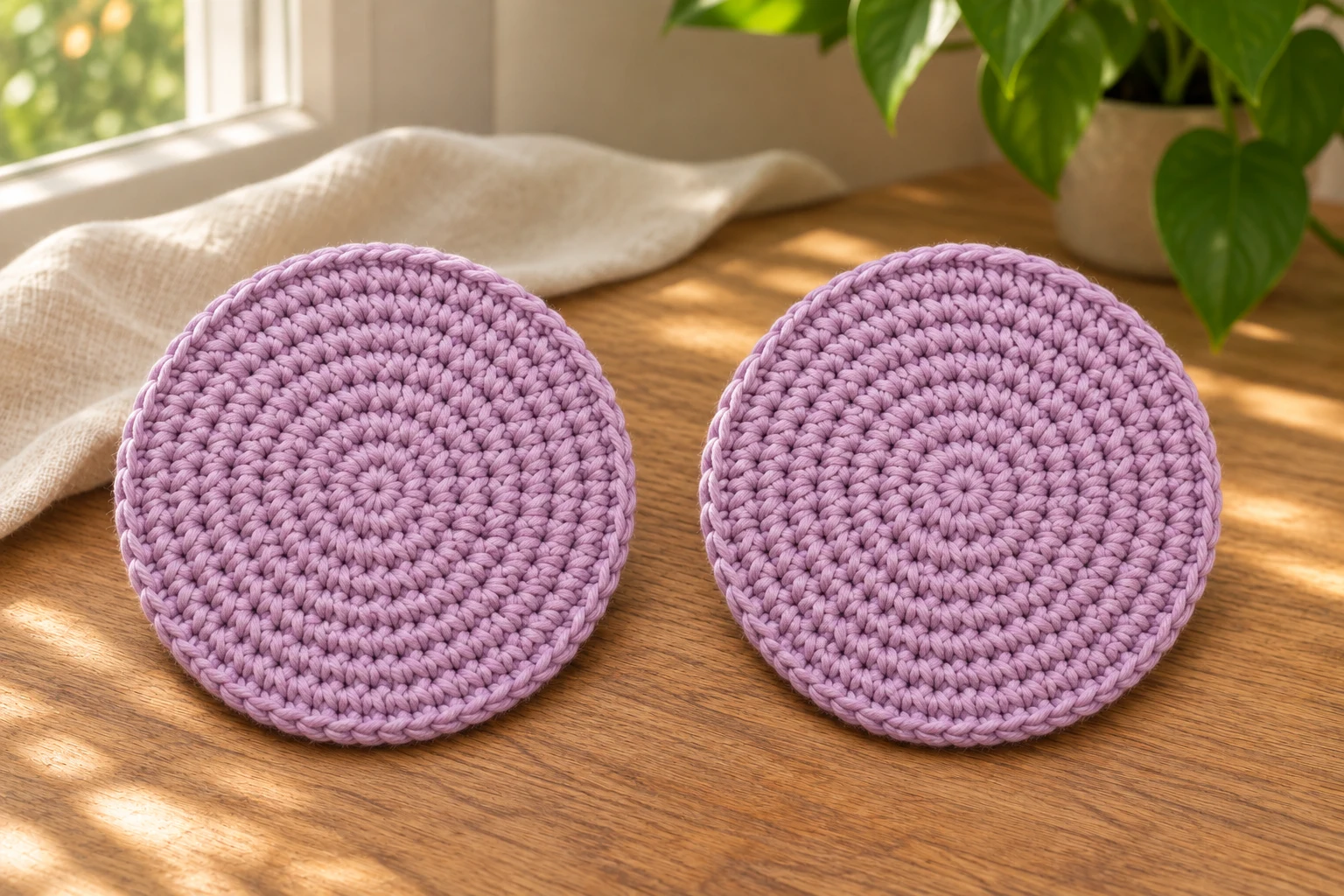
Make two flat matching disks. Mark each final rim into four twelve-stitch quarters. The disks should lie flat without being forced. A cupped or rippled rim will not match the body simply because its stitch count is correct.
Make the Rectangular Wrap
| Round / stage | Instructions | Count / check |
|---|---|---|
| Foundation | Ch 41 | 40 usable chains |
| 1 | Sc in second chain and across | 40 |
| 2–48 | Ch 1, turn; sc across | 40 each |
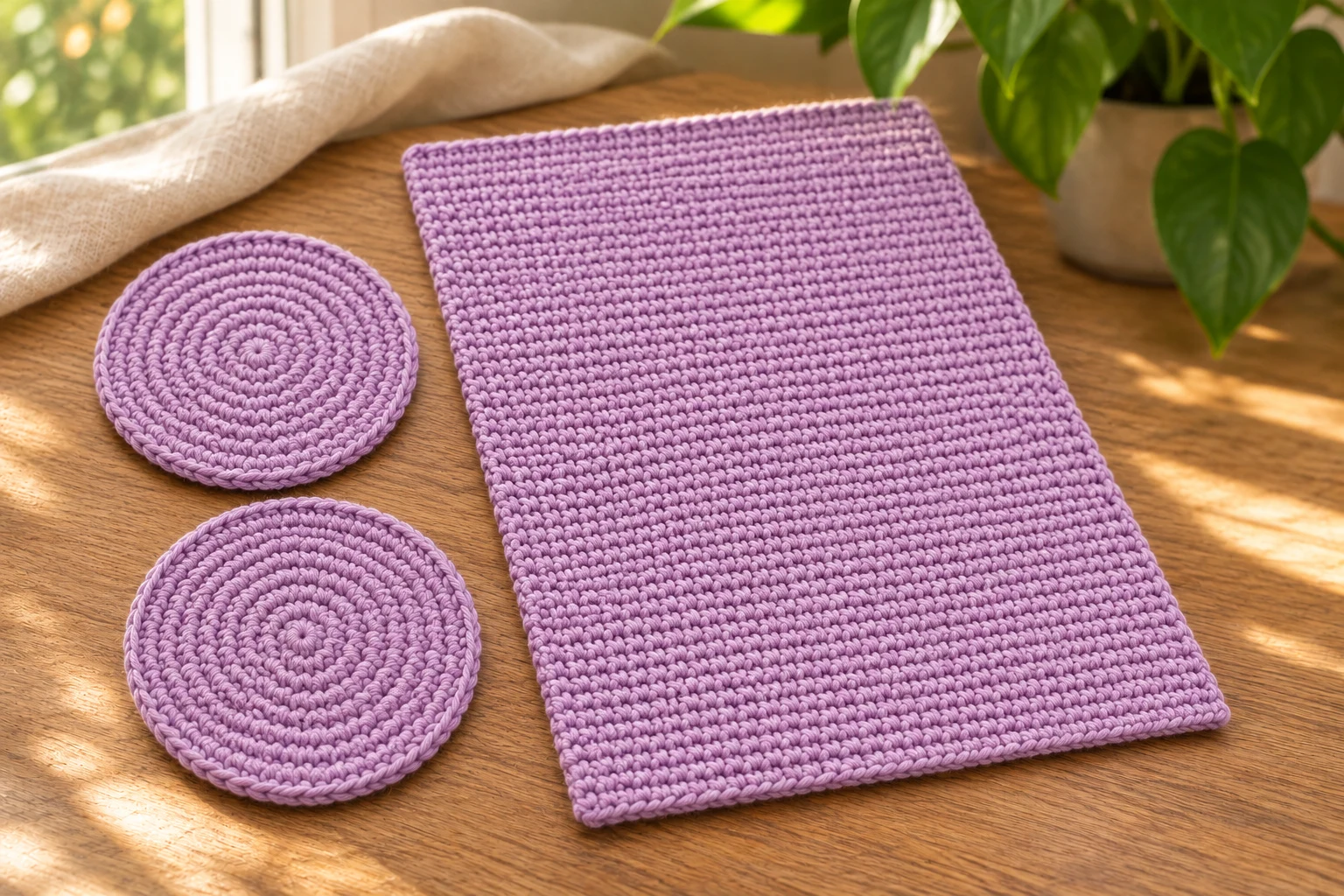
Mark the row ends into four twelve-row quarters on both short sides. Rest or block the fabric as appropriate for the cotton before measuring. Compare a body side with the actual circular rim: forty-eight row ends should distribute around forty-eight stitches with modest, even ease. Large length differences require a gauge correction before assembly.
Fit the Long Zipper
| Round / stage | Instructions | Count / check |
|---|---|---|
| Position | Place zipper between the two forty-stitch edges | Teeth clear of yarn |
| Tape | Baste one tape to each edge with matching strong thread | Measured full travel |
| Ends | Fold spare tape clear of the end seams | Stops remain accessible |
Choose the usable opening to fit the actual forty-stitch length, not a nominal label alone. The zipper tape adds width to the wrap. Pin a circular end temporarily before permanent sewing to check that the tape does not make the circumference excessive. If necessary, adjust the number of body rows before the zipper is sewn; record the fitted row count and distribute it evenly around each rim. The stated forty-eight-row version assumes the actual assembled wrap fits.
Join the Circular Ends
| Round / stage | Instructions | Count / check |
|---|---|---|
| Quarter marks | Match four body markers to circle markers | Four sections each side |
| Seam | Sew row-end fabric to successive rim stitches | 48 positions in base version |
| Second end | Align zipper at same top position | No barrel twist |
Keep the zipper partly open so the interior remains accessible. Pin both ends before tightening either seam. Sew each twelve-row section evenly across its twelve-stitch rim quarter, catching sound fabric rather than a loose edge loop. Reinforce the zipper-end junctions without sewing through teeth or trapping the slider. The two circles should sit parallel rather than canting in opposite directions.
Fit Two Webbing Handles
| Round / stage | Instructions | Count / check |
|---|---|---|
| Layout | One handle on each side of the zipper | Two separate handles |
| Roots | Each handle has two spaced roots on the same barrel side | Four broad overlaps |
| Sewing | Turn raw ends inward; sew perimeter and diagonals | Catch broad dense fabric |
Fit webbing lengths on the assembled empty bag before cutting. Each handle runs lengthwise along one side of the zipper, with its two roots spaced along that same barrel side. The other handle mirrors it across the opening. Leave enough rise for fingers and enough overlap for broad reinforcement. Temporarily open the zipper under both handles; they must not trap its slider. Sew using strong thread through multiple neighboring crochet stitches. The handle positions and seams still require a light physical trial over a table before practical use.
Inspect Shape and Seams
| Round / stage | Instructions | Count / check |
|---|---|---|
| Ends | Both disks remain round | No gathered corners |
| Closure | Zipper opens without catching fabric | Full usable travel |
| Handles | Four roots lie flat and do not distort zipper | No established carrying capacity |
Remove every pin and inspect the inside joins. Support the barrel while trying light intended contents over a table. Stop if a root stretches the fabric or the circle seam opens. The empty bag is soft and may flatten; that is expected from this unlined construction rather than proof of a faulty circular count.
Troubleshooting
| Problem | Likely cause | Adjustment |
|---|---|---|
| Ends cup | Round tension or increases wrong | Correct disks before sewing |
| Wrap too long | Row gauge or tape width ignored | Fit assembled circumference |
| Cylinder twists | Second end rotated | Align top zipper marks |
| Handle blocks slider | Root layout too close | Refit both handles |
Care and Related Projects
Follow cotton, webbing and zipper care labels. Empty before cleaning, reshape round ends while damp and dry fully. Inspect the four webbing roots and zipper-end joins after use.
For another useful construction reference, see this related crochet project. Its stitch counts and attachment positions belong to that project; keep the instructions for this design separate.
Frequently Asked Questions
Are the handles crocheted?
No. This version uses two tan cotton-webbing handles.
Why must both gauge directions be checked?
Body row ends meet circle stitches, so a large difference between row and stitch gauge affects the circumference fit.
Is the barrel rigid?
No stiffener is included. The round ends and seams define a soft shape.
Where does the zipper run?
Along the twenty-centimeter planned length between the two forty-stitch body edges.
Compact Pattern Card
| Stage | Key instruction |
|---|---|
| Crochet Two Circular Ends | Round n: ((n−2) sc, inc) × 6; join |
| Make the Rectangular Wrap | Ch 1, turn; sc across |
| Fit the Long Zipper | Fold spare tape clear of the end seams |
| Join the Circular Ends | Align zipper at same top position |
| Fit Two Webbing Handles | Turn raw ends inward; sew perimeter and diagonals |
| Inspect Shape and Seams | Four roots lie flat and do not distort zipper |