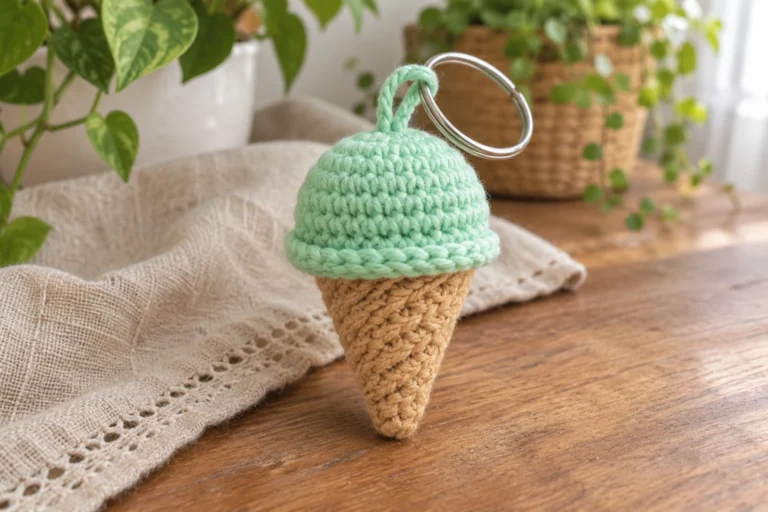
Crochet Heart Keychain Pattern with a Reinforced Hanging Loop
Crochet a small stuffed heart keychain from two joined lobes. Follow round tables, shaping notes and a doubled hanging-loop attachment with clear checks.
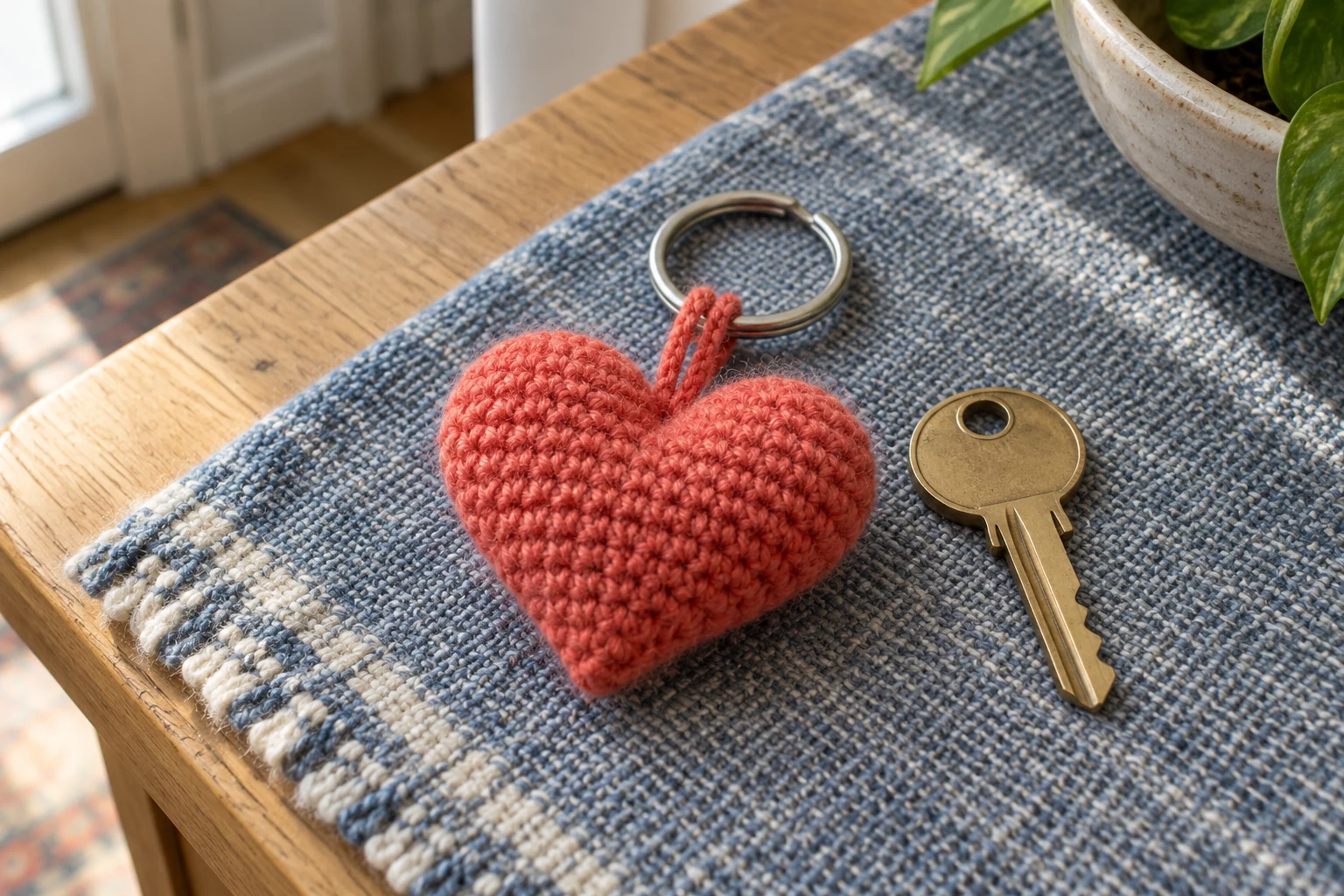
A small heart is a useful way to practice joining two rounded pieces without making a large amigurumi. This coral version has two equal lobes, a tapered lower point and a short doubled yarn loop for a split ring. The face is left plain so the heart shape remains the focus.
This crochet heart keychain pattern is worked in continuous rounds. Make the lobes separately, join them into one opening, and decrease toward the point. Add the hardware only after closing the body and checking the hanging loop.
How are the two heart lobes joined? Make two 18-stitch cups. Crochet around all 18 stitches of the first cup and all 18 of the second, creating one 36-stitch round. The subsequent rounds shape the lower heart. A few stitches close the small gap at the center notch.
Project Overview
| Detail | Pattern information |
|---|---|
| Skill | Confident beginner |
| Terms | US crochet |
| Construction | Two lobe cups joined into a single stuffed body |
| Hook | 2.5 mm or size that hides filling |
| Planning size | Roughly 5–6 cm wide; unverified |
| Estimated time | About 1–2 hours; experience dependent |
| Testing | Stitch arithmetic reviewed; hardware strength untested |
Illustrations and testing: The six project images are generated illustrations of the intended design, not photographs of a test-crocheted sample. The written instructions and stitch arithmetic have been reviewed; size, yarn use, handling and construction still need a physical sample check.
Materials
| Material | Suggested specification |
|---|---|
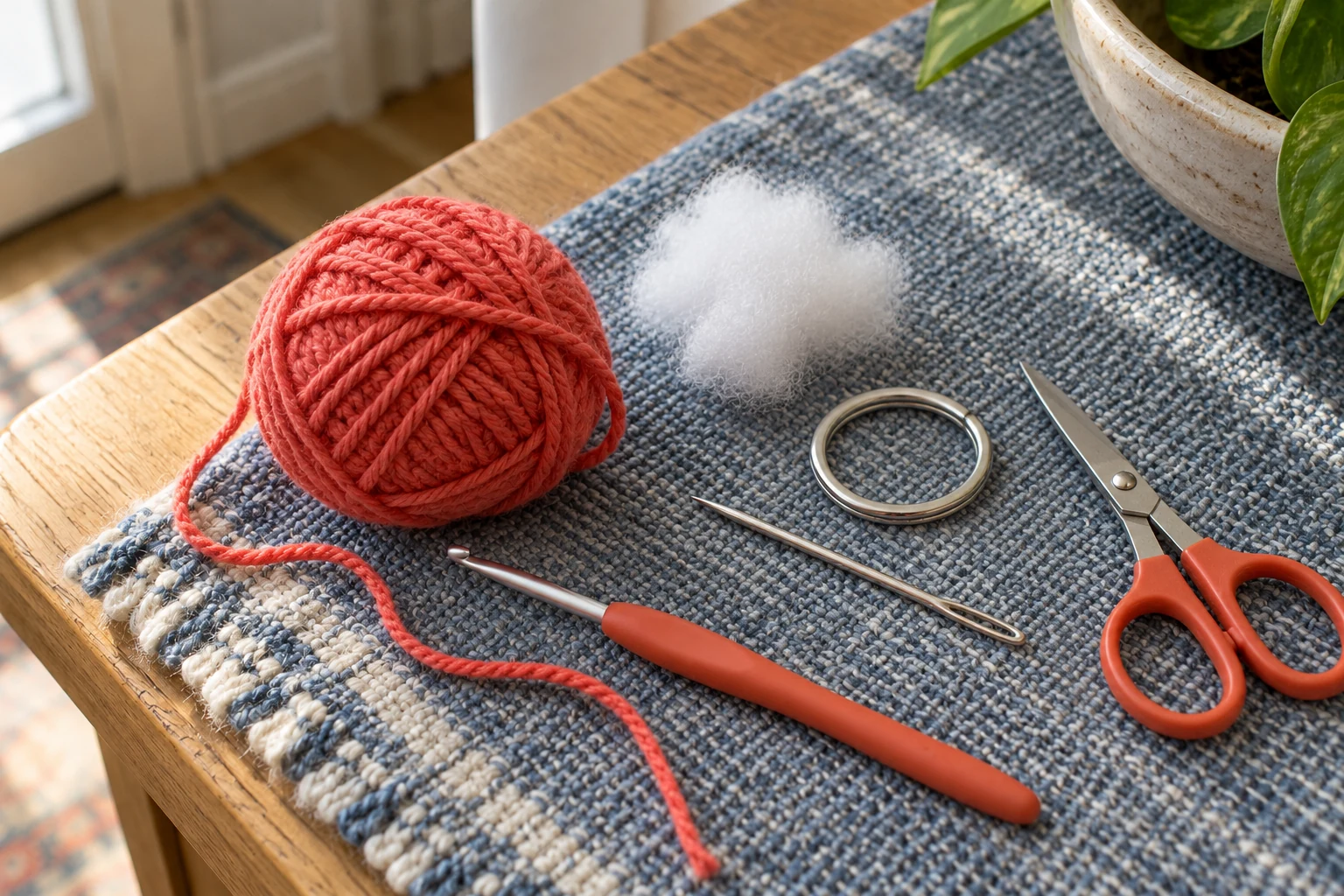
| Coral cotton | About 10–15 g fine/sport cotton, around 125 m per 50 g; estimate |
| Hook | 2.5 mm, adjusted for dense fabric |
| Filling | Small amount of polyester stuffing |
| Hardware | One plain split ring, approximately 20–25 mm |
| Notions | Blunt yarn needle, marker and scissors |
Size, Gauge, and Yarn Choices
A firm fabric matters more than a particular hook label. Crochet the first lobe and gently stretch it: if stuffing would show, use a smaller hook and remake both lobes consistently. The width is a planning estimate, not a measured sample dimension. Do not overstuff to reach a particular size; that can flatten the notch and spread the stitches. This is an adult accessory draft, not a tested toy or a load-bearing connector.
Abbreviations and Working Notes
| Abbreviation | Meaning |
|---|---|
| ch | Chain |
| sc | Single crochet |
| inc | 2 sc in the same stitch |
| dec | Invisible single crochet decrease; consumes 2 stitches and makes 1 |
| sl st | Slip stitch |
| st / sts | Stitch / stitches |
| MR | Magic ring |
Work in a continuous spiral without joining at round ends. Move a marker to the first stitch of each new round. There is no turning chain.
An invisible decrease consumes two adjacent stitches and makes one. The shaping repeats must fit the entire round. Keep both lobes at 18 stitches before joining.
Make the two cups with the same yarn and hook. Secure the magic-ring tails inside before the cups become difficult to reach.
Make Two Matching Heart Lobes
| Round | Instructions | Stitches |
|---|---|---|
| 1 | 6 sc in MR | 6 |
| 2 | Inc in every st | 12 |
| 3 | (Sc, inc) × 6 | 18 |
| 4–5 | Sc in every stitch for 2 rounds | 18 each |
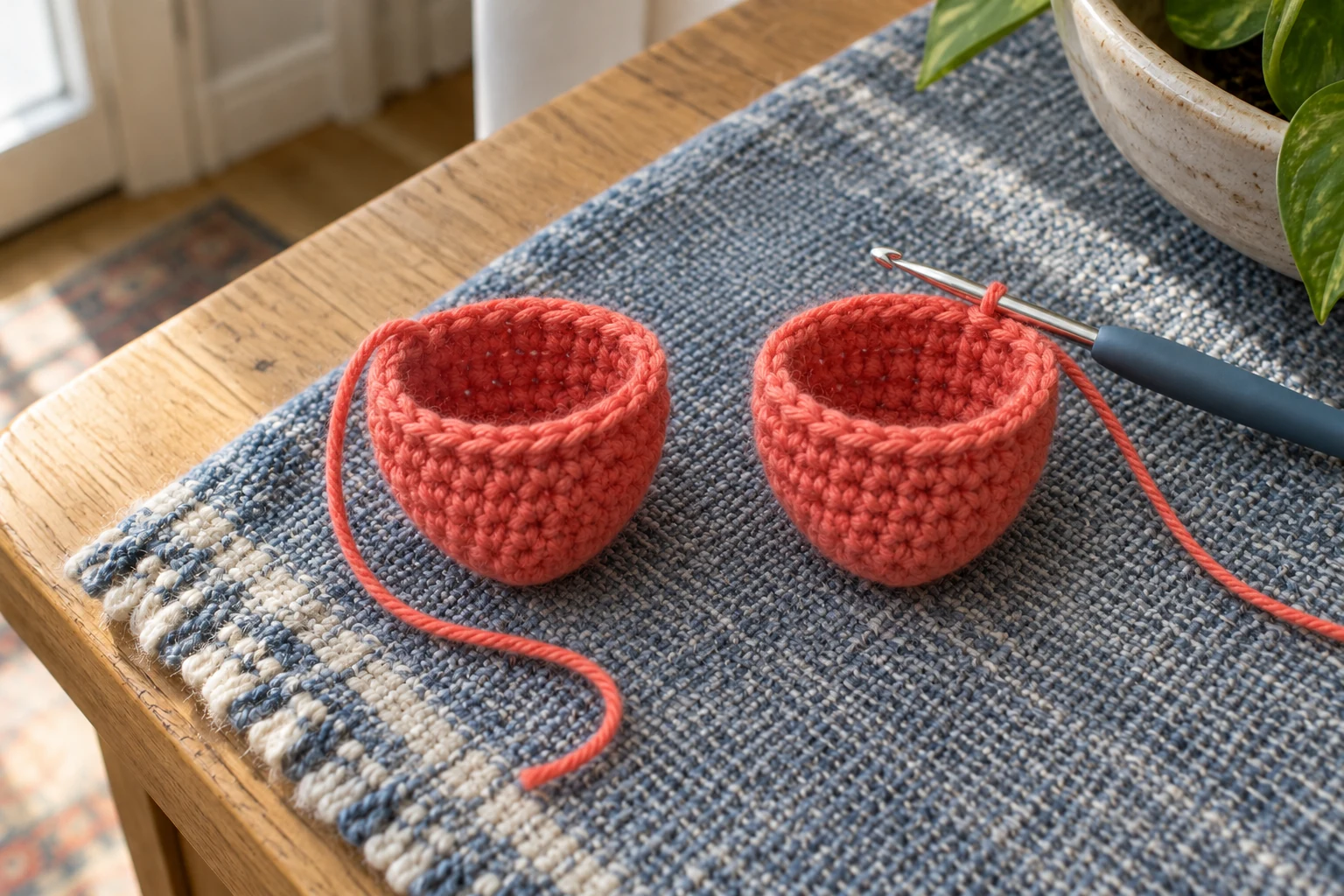
Make the first lobe, fasten off and leave a tail about 20 cm long for closing the center gap later. Make the second lobe the same way but do not fasten off. Lay them beside one another with the openings facing up. The working yarn remains on the second lobe.
Join the Lobes
Insert the hook into the first stitch of the first lobe and work 18 sc around that cup. Then work 18 sc around the second cup, including its first stitch, to complete one shared round. Do not add a chain bridge, skip any lobe stitches, or crochet the two rims together. Place the marker in the first stitch of this shared round.
| Body round | Instructions | Stitches |
|---|---|---|
| 6 | Sc around first lobe 18 times; sc around second lobe 18 times | 36 |
| 7–8 | Sc in every stitch for 2 rounds | 36 each |
| 9 | (4 sc, dec) × 6 | 30 |
| 10 | Sc in every stitch | 30 |
| 11 | (3 sc, dec) × 6 | 24 |
| 12 | Sc in every stitch | 24 |
| 13 | (2 sc, dec) × 6 | 18 |
| 14 | (Sc, dec) × 6 | 12 |
| 15 | Dec × 6 | 6 |
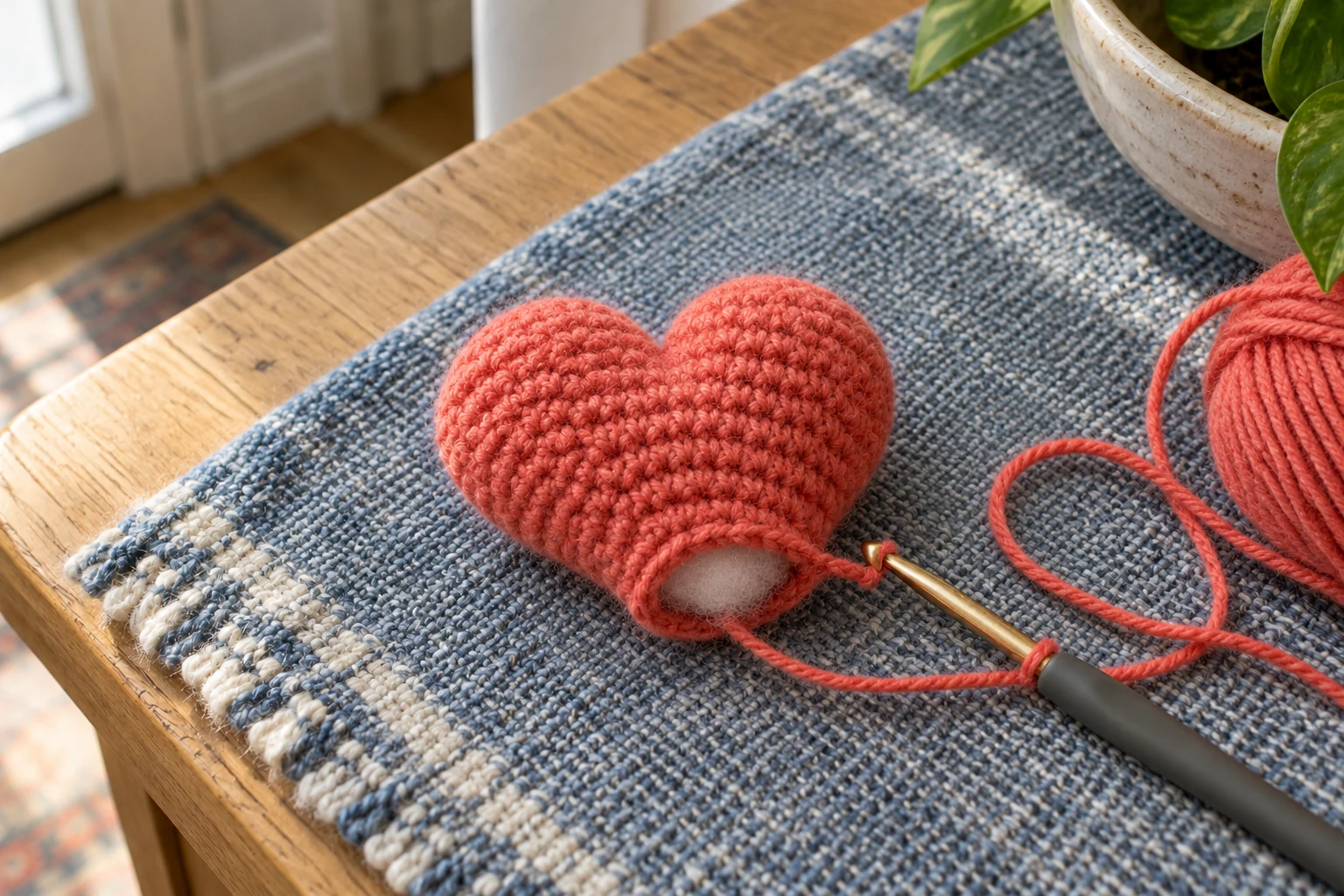
Pause after Round 10. Use the first lobe tail to close the small hole between the cups with a few matching stitches. Keep the notch defined without pulling the cups tightly together. Begin stuffing each lobe with small pieces, then add a lighter amount to the lower section as the opening narrows.
Before Round 15, check the front and back. The lobes should feel evenly filled, and the lower tip should not be stretched into a ball. After the final round, thread the yarn through the front loops of the remaining six stitches, pull closed and secure the end inside.
Add the Doubled Hanging Loop
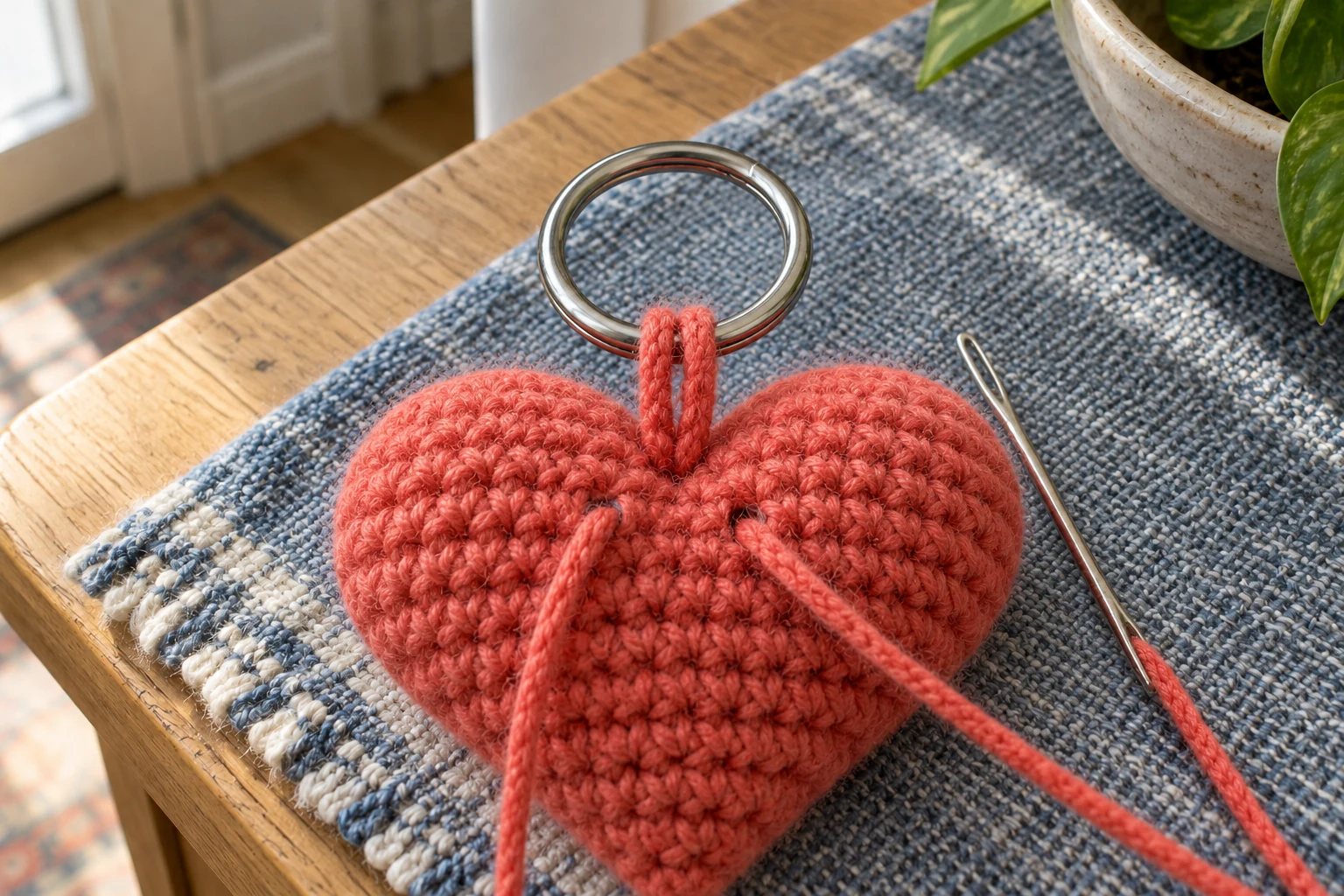
Cut about 25 cm of matching coral yarn. Pass the middle through the split ring and bring the two loose ends together, making a doubled strand between ring and heart. Position the ring just above the notch and choose a short loop length that clears the top without covering the heart.
Thread each end separately through several crochet stitches on the back, just below the notch. Follow different stitch paths rather than anchoring both ends to one loop. Secure the ends with small backstitches, weave them in different directions through the body fabric, and bury the remaining tails. The doubled strand and spread anchors reinforce the design, but they do not give a tested pulling strength.
Check the Shape and Attachment
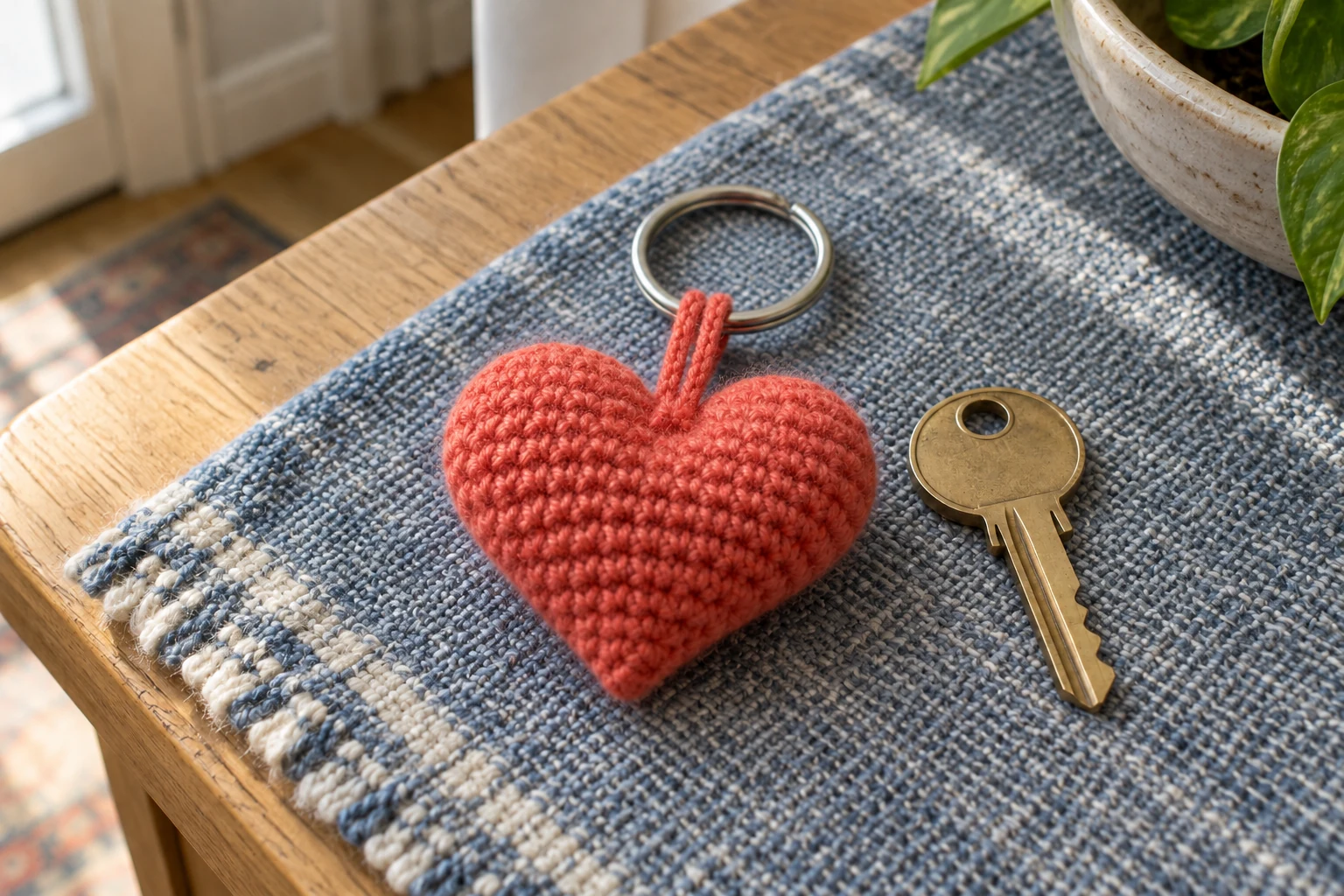
Lay the heart down and compare the lobes. Gently move filling with your fingers if one looks larger. Hold the heart in one hand and lightly pull the ring with the other over a table. If the fabric stretches open or any tail slips, remake the anchor before adding keys. Keep the key itself on the metal ring; do not make the crochet charm the only connector between valuable keys and a bag.
Troubleshooting
| Issue | Cause to check | Adjustment |
|---|---|---|
| Heart looks round | Notch pulled closed or lower section overstuffed | Ease the center seam and redistribute filling |
| One lobe is taller | Different round counts or tension | Check both 5-round cups before joining |
| Count is not 36 after joining | A rim stitch skipped or added | Use all 18 stitches of each cup, without a bridge |
| Stuffing shows | Loose fabric or too much filling | Use a smaller hook for a remake; reduce filling |
| Loop pulls loose | Anchors share one fragile stitch | Spread both tails through separate fabric paths |
Care and Related Projects
Spot clean around the yarn first. If the yarn label permits washing, remove keys and protect the metal ring from prolonged soaking. Let the filling dry completely before use. Inspect the loop and body regularly; a small charm can catch on door handles and zippers.
For a different charm construction, browse the mushroom keychain. If sewing the notch feels difficult, the amigurumi sewing guide explains how to hide small attachment stitches.
Frequently Asked Questions
Is this no-sew?
No. The cups join while crocheting, but the small center gap and the hardware loop are sewn.
Can I embroider initials?
Yes, before stuffing if possible. Keep the embroidery away from the hanging-loop anchors and avoid pulling the fabric into a dent.
Can I use chenille yarn?
It changes the size and may make tiny joins harder to inspect. Use suitable hardware and test the attachment rather than assuming the cotton version transfers directly.
Can I crochet the loop onto the body?
That would be a different attachment method. The instructions here use two sewn yarn ends so both anchoring paths can be inspected.
Why does Round 9 need six decreases?
The round begins with 36 stitches. Each repeat consumes six base stitches and produces five; six repeats therefore make 30 stitches.
Is it suitable for a baby?
No. A split ring and a small stuffed charm are not a tested baby toy. Keep the accessory away from babies and young children.
Compact Heart Keychain Pattern Card
| Part | Essential instructions |
|---|---|
| Each lobe | 6, 12, 18; then 2 rounds at 18 |
| Join | 18 + 18 = 36; no chain bridge |
| Body | 36, 36, 30, 30, 24, 24, 18, 12, 6 after joining round |
| Finishing | Close notch gap, stuff gently, close tip |
| Hardware | Doubled coral loop, separate sewn anchors, plain split ring |